
It is important to remember that today Azhkenzi jews represent almost half of all Jews of Israel, and of course did not return to any "promised land" of the distant past.
This helps to understand why the (majority) traditional inhabitants of Palestine (Israel) are the Palestinians and not the Ashkenazi Jews.
In the Palestine (today Israel) land Ashkenazi are recent newcomers.
In the following text a brief explanation of the Khazar kingdom is included
Khazaria, a prosperous Jewish kingdom in the
Middle Ages
The history
of Khazaria presents us with a fascinating example of how Jewish life
flourished in the Middle Ages. In a time when Jews were persecuted
thruout Christian Europe, the kingdom of Khazaria was a beacon of hope. Jews
were able to flourish in Khazaria because of the tolerance of the Khazar
rulers, who invited Byzantine and Persian Jewish refugees to settle in their
country. Due to the influence
of these refugees, the Khazars found the Jewish religion to be appealing
and adopted Judaism in large numbers.
Most of the available information about the Khazars comes
from Arabic, Hebrew, Armenian, Byzantine, and Slavic sources, most of which are
reliable. There is also a large quantity of archaeological evidence concerning
the Khazars that illuminates multiple aspects of the Khazarian economy (arts
and crafts, trade, agriculture, fishing, etc.) as well as burial practices.
Origins. The Khazars were a Turkic people who
originated in Central Asia. The early Turkic tribes were quite diverse,
although it is believed that reddish hair was predominant among them prior to
the Mongol conquests. In the beginning, the Khazars believed in Tengri shamanism, spoke a Turkic language, and were nomadic.
Later, the Khazars adopted Judaism, Islam, and Christianity, learned Hebrew and Slavic, and became settled in cities and towns thruout the north Caucasus and Ukraine. The Khazars had a great history of ethnic independence extending approximately 800 years from the 5th to the 13th century.
Later, the Khazars adopted Judaism, Islam, and Christianity, learned Hebrew and Slavic, and became settled in cities and towns thruout the north Caucasus and Ukraine. The Khazars had a great history of ethnic independence extending approximately 800 years from the 5th to the 13th century.
The earliest history of the Khazars in southern Russia,
prior to the middle of the 6th century, is hidden in obscurity. From about 550 to 630, the Khazars
were part of the Western Turkish Empire, ruled by the Celestial Blue Turku
(Kök Turks. When the Western Turkish Empire was broken up as a result of
civil wars in the middle of the 7th century, the Khazars successfully asserted
their independence. Yet, the Kök kaganate under which they had lived provided
the Khazars with their system of government. For example, the Khazars followed
the same guidelines as the Kök Turks regarding the succession of kings.
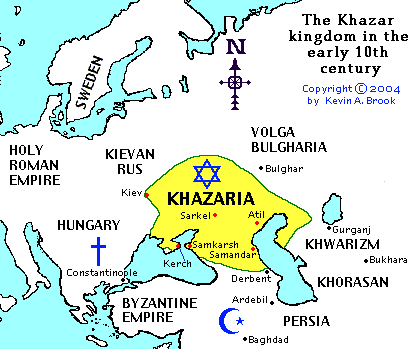
Political power. At its maximum extent, the independent
country of Khazaria included the geographic regions of southern Russia,
northern Caucasus, eastern Ukraine, Crimea, western Kazakhstan, and
northwestern Uzbekistan. Other Turkic groups such as the Sabirs and Bulgars
came under Khazar jurisdiction during the 7th century. The Khazars forced some
of the Bulgars (led by Asparukh) to move to modern-day Bulgaria, while other
Bulgars fled to the upper Volga River region where the independent state of
Volga Bulgharia was founded. The Khazars had their greatest power over other
tribes in the 9th century, controlling eastern Slavs, Magyars, Pechenegs,
Burtas, North Caucasian Huns, and other tribes and demanding tribute from them.
Because of their jurisdiction over the area, the Caspian Sea was named the
"Khazar Sea", and even today the Azeri, Turkish, Persian, and Arabic
languages designate the Caspian by this term (in Turkish, "Hazar
Denizi"; in Arabic, "Bahr-ul-Khazar"; in Persian, "Daryaye
Khazar").
In addition to their role in indirectly bringing about the
creation of the modern Balkan nation of Bulgaria, the Khazars played an even
more significant role in European affairs. By acting as a buffer state between
the Islamic world and the Christian world, Khazaria prevented Islam from
significantly spreading north of the Caucasus Mountains. This was accomplished
thru a series of wars known as the Arab-Khazar Wars, which took place in the
late 7th and early 8th centuries. The wars established the Caucasus and the city of Derbent as the
boundary between the Khazars and the Arabs.
Cities.
The first Khazar capital was Balanjar, which is identified with the
archaeological site Verkhneye Chir-Yurt. During the 720s, the Khazars
transferred their capital to Samandar, a coastal town in the north Caucasus
noted for its beautiful gardens and vineyards. In 750, the capital was moved to
the city of Itil (Atil) on the edge of the Volga River. In fact, the name
"Itil" also designated the Volga River in the medieval age. Itil
would remain the Khazar capital for at least another 200 years. Itil, the
administrative center of the Khazar kingdom, was located adjacent to Khazaran,
a major trading center. In the early 10th century, Khazaran-Itil's population
was composed mostly of Muslims and Jews, but a few Christians lived there also.
The capital city had many mosques. The king's palace was located on an island
nearby, which was surrounded by a brick wall. The Khazars stayed in their
capital during the winter, but they lived in the surrounding steppe in the
spring and summer to cultivate their crops.
The great capital city of modern Ukraine, Kiev, was founded
by Khazars or Hungarians. Kiev is a Turkic place name (Küi = riverbank + ev =
settlement). A community of Jewish Khazars lived in Kiev. Other towns of the
Khazars, many of which also had important Jewish communities, included Kerch
(Bospor), Feodosia, Tamatarkha (Tmutorokan), Chufut-Kale, Sudak, and Sarkel. The
local governor of Samandar was Jewish, and it may be assumed that many of the
governors of these other localities were also Jewish. A major brick fortress
was built in 834 in Sarkel, along the Don River. It was a cooperative
Byzantine-Khazar venture, and Petronas Kamateros, a Greek, served as chief
engineer during the construction.
Civilization and trade. The staple foods for the Khazars
were rice and fish. Barley, wheat, melons, hemp, and cucumbers were also
harvested in Khazaria. There were many orchards and fertile regions around the
Volga River, which the Khazars depended upon due to the infrequency of rain. The
Khazars hunted foxes, rabbits, and beavers to supply the large demand for furs.
Khazaria was an important trade route connecting Asia and
Europe. For example, the "Silk Road" was an important link between
China, Central Asia, and Europe. Among the things traded along the Khazar trade
routes were silks, furs, candlewax, honey, jewelry, silverware, coins, and
spices.Jewish
Radhanite traders of Persia passed thru Itil on their way to western
Europe, China, and other locations. The Iranian Sogdians also made use of the
Silk Road trade, and their language and runic letters became popular among the
Turks. Khazars traded with the people of Khwarizm (northwest Uzbekistan) and
Volga Bulgharia and also with port cities in Azerbaijan and Persia.
The Khazars' dual-monarchy was
a Turkic system under which the kagan was the supreme king and the bek was the
civilian army leader. The kagans were part of the Turkic Asena ruling family
that had provided kagans for other Central Asian nations in the early medieval
period. The Khazar kagans had relations with the rulers of the Byzantines,
Abkhazians, Hungarians, and Armenians. To some extent, the Khazarian kings
influenced the religion of the Khazar people, but they tolerated those who had
different religions than their own, so that even when these kings adopted
Judaism they still let Greek Christians, pagan Slavs, and Muslim Iranians live
in their domains. In the capital city, the Khazars established a supreme court
composed of 7 members, and every religion was represented on this judicial
panel (according to one contemporary Arab chronicle, the Khazars were judged
according to the Torah, while the other tribes were judged according to other
laws).
Ancient communities of Jews existed in the Crimean
Peninsula, a fact proven by much archaeological evidence. It is significant
that the Crimea came under the control of the Khazars. The Crimean Jewish
communities were later supplemented by refugee Jews fleeing the Mazdaq
rebellion in Persia, the persecutions of Byzantine emperors Leo III and Romanus
I Lecapenus, and for a variety of other reasons. Jews came to Khazaria from
modern-day Uzbekistan, Armenia, Hungary, Syria, Turkey, Iraq, and many other
places, as documented by al-Masudi, the Schechter Letter, Saadiah Gaon, and
other accounts. The Arabic writer Dimashqi wrote that these refugee Jews
offered their religion to the Khazar Turks and that the Khazars "found it
better than their own and accepted it". The Jewish Radhanite traders may
have also influenced the conversion. Adopting Judaism was perhaps also a symbol
of political independence for Khazaria, holding the balance of power between
Muslim Caliphate and the Christian Byzantine Empire.
Under the leadership of kings Bulan and Obadiah, the
standard rabbinical form of the Jewish religion spread among the Khazars. King
Bulan adopted Judaism in approximately the year 838, after supposedly holding a
debate between representatives of the Jewish, Christian, and Muslim faiths. The
Khazar nobility and many of the common people also became Jews. King Obadiah
later established synagogues and Jewish schools in Khazaria. The books of the
Mishnah, Talmud, and Torah thus became important to many Khazars. Saint
Cyril came to Khazaria in 860 in a Byzantine attempt to convert the
Khazars to Christianity, but he was unsuccessful in converting them away from
Judaism. He did, however, convince many of the Slavs to adopt Christianity. By
the 10th century, the Khazars wrote using Hebrew letters. The major Khazar
Jewish documents from that period were written in the Hebrew language. The
Ukrainian professor Omeljan Pritsak estimated that there were as many as 30,000
Jews in Khazaria by the 10th century. In 2002, the Swedish numismatist Gert
Rispling discovered a Khazar Jewish coin.
 In
general, the Khazars may be described as a productive and tolerant people, in
contact with much of the rest of the world and providing goods and services at
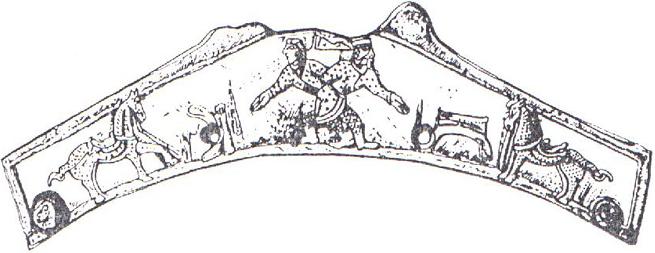
home and abroad. Many
artifacts from the Khazars, exhibiting their artistic and industrial talents,
have survived to the present day.
In
general, the Khazars may be described as a productive and tolerant people, in
contact with much of the rest of the world and providing goods and services at
home and abroad. Many
artifacts from the Khazars, exhibiting their artistic and industrial talents,
have survived to the present day.
Decline and fall. During the 10th century, the East Slavs
were united under Scandinavian overlordship. A new nation, Kievan Rus, was
formed by Prince Oleg. Just as the Khazars had left their mark on other
peoples, so too did they influence the Rus. The Rus and the Hungarians both adopted the dual-kingship
system of the Khazars. The Rus princes even borrowed the title kagan.
Archaeologists recovered a variety of Khazar or Khazar-style objects (including
clothing and pottery) from Viking gravesites in Chernigov, Gnezdovo, Kiev, and
even Birka (Sweden). The residents of Kievan Rus patterned their legal
procedures after the Khazars. In addition, some Khazar words became part of the
old East Slavic language: for example, bogatyr ("brave
knight") apparently derives from the Khazar word baghatur.
The Rus inherited most of the former Khazar lands in the
late 10th century and early 11th century. One of the most devastating defeats came in 965, when Rus Prince
Svyatoslav conquered the Khazar fortress of Sarkel. It is believed
that he conquered Itil two years later, after which he campaigned in the
Balkans. Despite the loss of their nation, the Khazar people did not disappear.
Many of them converted to Islam and survived in the North Caucasus and Central
Asian regions under new identities. Others lived and studied in other Jewish
communities from Spain to the Byzantine Empire2 but in the end had no
impact on the ancestral composition of any modern Jewish population.
Notes.
"The Khazar people were an unusual
phenomenon for Medieval times. Surrounded by savage and nomadic tribes, they had
all the advantages of the developed countries: structured government, vast and
prosperous trading, and a permanent army. At the time, when great fanatism and
deep ignorance contested their dominion over Western Europe, the Khazar state
was famous for its justice and tolerance. People persecuted for their faiths
flocked into Khazaria from everywhere. As a glistening star it shone brightly
on the gloomy horizon of Europe, and faded away without leaving any traces of
existence." - Vasilii V. Grigoriev, in his essay "O
dvoystvennosti verkhovnoy vlasti u khazarov" (1835), reprinted in his 1876
compilation book Rossiya i Aziya on page 66
"Though the Jews were everywhere a subject
people, and in much of the world persecuted as well, Khazaria was the one place
in the medieval world where the Jews actually were their own masters.... To the
oppressed Jews of the world, the Khazars were a source of pride and hope, for
their existence seemed to prove that God had not completely abandoned His
people."- Raymond Scheindlin,
in The Chronicles of the Jewish People (1996)
1. Many medieval writers attested to the Khazars' Turkic origins including Theophanes, al-Masudi, Rabbi Yehudah ben Barzillai, Martinus Oppaviensis, and the anonymous authors of the Georgian Chronicle and Chinese chronicle T'ang-shu. The Arabic writer al-Masudi in Kitab at-Tanbih wrote: "...the Khazars... are a tribe of the Turks." (cited in Peter Golden, Khazar Studies, pp. 57-58). T'ang-shu reads: "K'o-sa [Khazars]... belong to the stock of the Turks." (cited in Peter Golden, Khazar Studies, p. 58). In his Chronographia, Theophanes wrote: "During his [Byzantine emperor Heraclius] stay there [in Lazica], he invited the eastern Turks, who are called Chazars, to become his allies." (cited in Theophanes, The Chronicle of Theophanes Confessor, translated by Cyril Mango and Roger Scott, 1997, p. 446). The claim that the Khazars were Scythians is completely without merit.
2. Timothy Miller discovered that Jewish Khazars were members of the Jewish community of Pera in the Byzantine Empire around the 11th century (see Timothy S. Miller, "The Legend of Saint Zotikos According to Constantine Akropolites," Analecta Bollandiana vol. 112, 1994, pp. 339-376).
Suggestions for further research. Here are some useful
published introductory materials on the Khazars. Some are available from retail
bookstores, while others are only available through libraries.
“The Jews
of Khazaria” by Kevin Alan Brook (2018). 10 chapters,
plus glossary, timeline, bibliography, maps, notes.
“The World
of the Khazars edited by Peter B. Golden, Haggai Ben-Shammai, and András
Róna-Tas (2007)
“Khazarian
Hebrew doments of the Tenth Century by Norman Golb and Omeljan Pritsak (1982). .
“The
History of the Jewish Khazars” by Douglas M. Dunlop (1954, 1967)
"Khazar
Studies: An Historico-Philological Inquiry into the Origins of the
Khazars" by Peter B. Golden (1980)
Journal
article "Khazaria and Judaism" by P.B.Golden, in Archivum
Eurasiae Medii Aevi, volume 3, 1983, pages 128 to 156.
“The
Kuzari: in Defense of the Despised Faith by Yehudah HaLevi, translated by
N. Daniel Korobkin (1998, 2009)
From:
http://www.khazaria.com/khazar-history.html

No comments:
Post a Comment