Showing posts with label Fred Hoyle. Show all posts

Tuesday, June 11, 2019

About panspermia

Extracted from Inverview  of Fred Hoyle by Brig Klyce

source panspermia.org.

Early Biological Influences

One fortunate aspect is that my father was a direct believer in Darwin's theory. He used to tell me it was a wonderful thing, the greatest thing in science. I would say no, Newton is the greatest thing in science. He would try to explain to me Darwin's idea because he was an uneducated man — self educated I should say. Maybe he didn't do too good a job. And so, I started by thinking this is a lot of bunkum, you see, at the age of 12 or so. I just didn't believe it. I knew a lot about — I had been brought up in the country and I knew all the flowers and all this sort of stuff. And I just did not believe it.
At Cambridge I made friends with an Irishman from the north, George Carson. He had come over from the University there to do a Ph.D. in Botany here. Later when I was a research student — you didn't live in college in those days, you lived in the town. People let out rooms to advanced students, maybe 2 students. It was better if the chap you roomed with was some one you knew and got along well with. The chap I roomed with was Carson. He had just got a job.
George was a very skeptical about Darwin's theory. He always had the view that if he did the right mathematics, it would be revealed to you what was wrong with it. George always had this suspicion. But these were just biasing seeds, as it were. At that time, I never got into panspermia, in fact, didn't believe it at all. I thought it was a lot of nonsense all through the years. Until in 1975 — that's when I got involved....

From Grains to Bacteria

...Because what happened was that I put Chandra on to the problem of what the interstellar grains are and understanding their properties. And all through the sixties we thought we were doing quite well, but it was like Kepler's analysis of the motion of Mars. He had proved Copernicus's theory quite substantially, but it still was not really based on the best observations. There were small discrepancies. Eventually he became dissatisfied with these small discrepancies and it was then that he decided that instead of fitting the observations and theory, see what the observations really implied for the shape of the orbits. He would look at it that way round — observation first. Then he decided that it was an ellipse. Starting with the observations was the correct way. Chandra did the same thing. We would calculate all manner of models with different properties. There would always be decrepancies in what should have been a very simple problem — something you could calculate exactly using a digital computer.
I was working in the States in seventy-four. When I left to go there, I was under the impression that what we had done in the way of graphite particles and silicates was giving adequate results. When I came back to England there was a conference and Chandra said to me, "I'm doing to better to remove those small discrepancies if the particles are organic." That was the line of research he had pursued during the year I was away. He was adding the infrared information which we hadn't had before. At that time, we tried to fit the infrared. I discussed it. I didn't know if he was right or not. I made an unguarded remark — I said, "But Chandra, if the interstellar material is organic, if that is true, then, there is so much of it that this will be better precursor material for biology than to do it on the earth in Urey-Miller fashion." That was the unguarded remark. That set him off and then he must have looked through hundreds and hundreds of spectra to fit the infrared data among organics. And then quite suddenly as soon as he moved to biological specimens, that fit it better than anything else.
That was the history until one evening, I had been out walking in the hills and settled in front of the fire for coffee after dinner. By now he had started sending me books from the Cardiff Library. I was checking through this book and I came on the page of a diagram, a drawing of a bacteria that had been dried out. The worst source of discrepancies in our calculation was that the particle — we had always been taking them as solid, not as hollow. We discovered that if the particles are seventy percent hollow, most of our difficulties immediately disappeared. It wasn't so much a question of composition as of being hollow. That was the key point. We had never been able to remove the "knee" in the curve of the visual stuff. Lots of things we tried to adjust. It didn't do much good. It turned out it really didn't matter. They were irrelevant parameters. The key thing was to get it hollow. In other words, to get the average index of refraction low. Well — the page I discovered of the bacterium being dried out — we reproduced it from time to time. It shows that, cell walls being very strong, they don't shrivel at all. The bacterium maintains its outer envelope — this is important — with the space enveloped. And then I looked to see how much space is enveloped and the space is seventy percent. So it was from there I switched round.
So I said let's calculate. Let's get a size distribution. Use the size distribution for bacteria because we don't have to assume it, we can look in the books and see what it is, and use what it is. We know nothing about bacteria at this point, until we talked to somebody who gave us routine information. Then Chandra discovers, to his horror, that there are a million species of bacteria, and this is not do-able. He can't count a million. So we have to specify some restriction and we finally decided to keep it to spore-forming bacteria — that didn't seem to be a problem that related to the sizes and so he was able to count those. By now he had a program for his computer which, as soon as he fed it the relevant physical information of the size distribution, within an hour he had the answer. He simply called me three days later and said, "I've got a perfect fit."
It's my nature — I recognize that it must be an accident in my upbringing and the turn of the century when I was at the university — I just go from observation. I don't say, "It's absurd that there should be bacteria in space." I don't say that. It fits the observation, so it's the best theory we have. I don't care if it's absurd. So I didn't hesitate to publish it. That of course was the beginning of the disaster, the ridiculous. [With irony, of those who ridiculed the finding:] They know! They're born to know that the particles in space are not bacteria. God has told them.

Thursday, March 14, 2019

Hoyle and Wickramasinghe's Analysis of Interstellar Dust 

Almost always the men who achieve these fundamental inventions of a new paradigm have been either very young or very new to the field whose paradigm they change. — Thomas Kuhn
The astronomer Sir Fred Hoyle was born in Bingley, Yorkshire, England on June 24, 1915. He received a master's degree from Cambridge in 1939 and was elected Fellow, St. John's College, Cambridge in the same year. He rose to become Plumian Professor of Astrophysics and Natural Philosophy in 1958. He was a leading contributor in the discovery of how the elements from lithium to iron are synthesized inside stars. In 1997 he was awarded the Crafoord Prize by the the Swedish Academy in recognition of outstanding basic research in fields not covered by the Nobel prize.
Professor N. Chandra Wickramasinghe was born in Colombo, Sri Lanka, on January 20, 1939. He studied astrophysics at Cambridge, where he was a student of Hoyle's. He received his Ph.D. in 1963 and an Sc.D. in 1973, and served on the faculty at Cambridge. He later became a Professor of Applied Mathematics and Astronomy at the University College, Cardiff, Wales. He is an expert in the use of infrared astronomy to study interstellar matter.
These two scientists did not originally set out to prove that life comes from space. They were astronomers, not biologists. They were trying to identify the contents of interstellar dust by finding something that would match its infrared signature, or extinction spectrum. When they began working on this problem in the early 1960s, the standard theory was that the spectrum could be adequately explained by graphite grains. But an imperfect match between the theoretical and actual spectra, and an implausible account of the formation of the grains pushed Hoyle and Wickramasinghe to search elsewhere. In their work and others', molecules that are more closely related to biology began to enter the picture.
In 1968, polycyclic aromatic molecules were detected in interstellar dust (4). In 1972, convincing evidence that the dust contained porphyrins was obtained (5). Then in 1974, Wickramasinghe demonstrated that there are complex organic polymers, specifically molecules of "polyformaldehyde", in space (6). These molecules are closely related to cellulose, which is very abundant in biology. By 1975, Hoyle and Wickramasinghe were convinced that organic polymers were a substantial fraction of the dust. This line of thought was considered wildly speculative at that time. Now however, the idea that organic polymers in space are abundant and may be necessary for life is well accepted. Today we often see stories about things like vinegar among the stars (7), or "buckyballs" from space as "the seeds of life" (8). To that extent the scientific paradigm for the origin of life on Earth has already shifted.
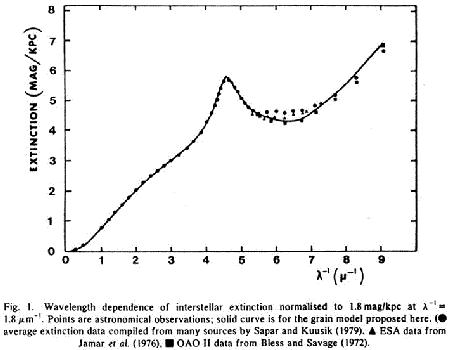
Graph of extinction spectrum of interstellar dust

But Hoyle and Wickramasinghe were not satisfied. In the middle 1970s, they turned their attention to an apparent anomaly in the spectrum. It had a low, broad "knee" centered at about 2.3 wavelengths per micrometer (the slight convexity on the slope at the left side of the graph above)  This spectral feature could be explained if the grains of dust were of a certain size, and translucent. After trying almost everything else first, in 1979, they looked at the spectrum for bacteria. Dried bacteria refract light as irregular hollow spheres, and their size range is appropriate. The match between the spectrum for dried bacteria (solid line) and the ones from the interstellar grains (dots, triangles and squares) was nearly perfect. Thinking without prejudice, Hoyle and Wickramasinghe concluded the grains probably were dried, frozen bacteria .

By Brig Kluce
From panspermia.org

Thursday, November 16, 2017

The astrophysicist who denied the Big Bang and supported the extraterrestrial origin of life


"The centenary of the birth of Fred Hoyle, a heterodox and highly creative scientist is celebrated
He never settled for the most widely accepted explanations and challenged many well-established theories.
The astronomer Rafael Bachiller shows us in this series the most spectacular phenomena of the Cosmos. Topics of pulsating research, astronomical adventures and scientific novelties about the Universe analyzed in depth.
The figure of Fred Hoyle (1915-2001) does not leave indifferent any contemporary astronomer. Researcher, professor and author of science fiction, Hoyle developed the theory of stellar nucleosynthesis and applied Einstein's equations to describe the universe. A heterodox scientist of enormous creativity, he never settled for the most widely accepted explanations and challenged, with original ideas, many well-established theories.
Prodigious intelligence
Fred Hoyle was born in Bingley (United Kingdom) on June 24, 1915. He was educated in Cambridge, where since childhood he proved to have a prodigious intelligence. From there he left at the end of 1940, in the middle of the world war, to go to work on radars in Portsmouth; there he met the physicists Hermann Bondi and Thomas Gold with whom he would later make several of his scientific works. This work also offered him the opportunity to travel to the US twice, where he was able to discuss with Caltech astronomers and the Monte Palomar Observatory, exchanges that turned out to be very inspiring for his subsequent work on nucelosynthesis.

Fred Hoyle in his maturity.
In 1945, once the war was over, Hoyle returned to Cambridge and at his university he would enjoy his most scientifically productive years. In 1967 he founded the prestigious Institute of Astronomy of Cambridge (then called Institute of Theoretical Astronomy), of which he would be its first director. In 1971 he was appointed president of the Royal Astronomical Society and in 1972 Knight of the British Empire ('Sir').
But in 1973 he resigned from his position as director of the Institute of Astronomy, remaining without stable salary and disconnected from the world of official astronomy. It was then that he moved to the Lake District, in northwest England, and devoted himself to writing books (many of them science fiction) and exploring heterodox ideas, most of which have been rejected by official science. On November 24, 1997 he suffered a fall during a country trip that had serious effects on his physical and intellectual state. He died on August 20, 2001 after a stroke in Bournemouth.
Nucleosynthesis
In 1946, Hoyle showed that the nuclei of stars can reach temperatures of billions of degrees, much higher than those that are required to trigger nuclear reactions, and that at those temperatures, the balance between nuclear processes should lead to a great abundance of carbon and iron, as observed in nature. He also identified the nuclear reactions that create the elements of the periodic table that lie between carbon and iron, and proposed that some of the precise reactions to create the heavier elements only happened when the stars exploded in the form of supernovas. These works gave birth to an entire astrophysical discipline, nucleosynthesis, which explains the origin of heavier elements than helium from different nuclear reactions.
Big Bang Challenge
Hoyle never agreed with the theory developed by George Lemaître about the expansion of the Universe. Although this theory was verified experimentally shortly after by Hubble, confirmed that the universe had an origin, Hoyle referred to all this as if it were pseudoscience. In a broadcast of the BBC in 1949 he referred for the first time to this theory, with a clear pejorative intention, with the term 'Big Bang'. I could not think at that moment that, with this ironic comment, I was coining the world-popular designation to that theory to which I would dedicate so much trying to refute it.

Mosaic with Hoyle in the National Gallery, London. | Boris Anrep
The British astronomer was a defender of his "theory of the stationary universe" that tried to justify that the universe remained eternally identical to itself, without any change, that it had not had an origin, nor would it have an end. To ensure that the separation of the galaxies from each other, which had been observed by Hubble, did not cause a dilution of the universe, Hoyle was forced to assume that there was matter that was created continuously between the galaxies, giving rise to new galaxies that occupied the space that was emptied during the expansion.
Obviously this creation of matter proposed by Hoyle was no more plausible than the creation of the entire universe in a single Big Bang, but what made this last theory prevail over that of the stationary universe was the discovery of the cosmic microwave background in 1964, which is considered a relic of the great explosion. Although this cosmic background does not find an explanation in Hoyle's theory, he died in 2001 without having accepted the validity of the Big Bang theory.
Scientific controversies
Together with his Indian collaborator Chandra Wickramasinghe, Hoyle promoted the idea of ​​panspermia, arguing that the first forms of life came to Earth from space and that, thanks to comets, life can spread throughout the universe.
.
These two authors also attributed an extraterrestrial origin to some diseases such as polio, mad cow disease, AIDS and the Spanish flu pandemic of 1918. For example, in the case of the Spanish flu, they hypothesized that a comet had deposited the virus in different parts of the planet simultaneously, a hypothesis that was unanimously rejected by experts in the pandemic.
In 1982 they published the book 'Evolution from space' in which they argued that the probability of obtaining a cell was ridiculously small. According to a comparison that has become famous, the probability of obtaining a cell from a primordial chemical soup is as small as the probability that a tornado could create a Boeing 747 in a junkyard. From here, although Hoyle declared himself an atheist, he went on to defend a theory of the 'Intelligent Design' type according to which life must have been created by some superior intelligence.
Hoyle supported the theory of the inorganic origin of terrestrial hydrocarbons according to which oil is not a fossil deposit of biological origin, but arises from large carbon deposits existing on Earth from its origin, or arrived at our planet through impacts of comets or asteroids...." 
"The most famous work of science fiction written by Hoyle, 'The black cloud', relates the arrival of a huge cloud of gas to the solar system. By shielding sunlight, the cloud seems capable of ending life on Earth. Finally, the cloud is revealed as a superorganism much more intelligent than human beings. This story conquered all the readers of the time passionate about science.

Hoyle starred in several controversies surrounding the delivery of the Nobel Prizes. For example, in 1974 when Antony Hewish won the prize for the discovery of pulsars, Hoyle immediately pointed out that the real discoverer had been Jocelyn Bell, and not Hewish, her thesis director. According to some authors, these criticisms of the Nobel were the cause of never being awarded the prize to himself, although he was received in 1983 by his collaborator in the work of nucleosynthesis, the American Willy Fowler."

Rafael Bachiller
Reference: 
http://www.elmundo.es/ciencia/2015/06/24/558a71c4ca4741504f8b4575.html

Tuesday, August 29, 2017

Plot of "The Black Cloud" novel by Fred Hoyle
"In 1964, astrophysicists on Earth become aware of a cloud of gas and dust, initially thought to be a Bok globule, that is heading for the solar system. The cloud, if interposed between the Sun and the Earth, could wipe out most of the life on Earth by blocking solar radiation and ending photosynthesis. A cadre of astronomers and other scientists is drawn together in Nortonstowe, England, to study the cloud and report to the British government about the consequences of its presence.
The cloud unexpectedly decelerates as it approaches and comes to rest around the Sun, causing disastrous climatic changes on Earth and immense mortality and suffering for the human race. As the behaviour of the cloud proves to be impossible to predict scientifically, the team at Nortonstowe eventually come to the conclusion that it might be a life-form with a degree of intelligence. The scientists try to communicate with the cloud, and succeed. The cloud is revealed to be an alien gaseous superorganism, many times more intelligent than humans, which is surprised to find intelligent life-forms on a solid planet. It reconfigures itself to allow sunlight to return to the Earth and humanity is saved.
Though its ill-effects on humanity have ceased, several governments are mistrustful of the cloud and prepare a nuclear attack upon it. When the scientists alert the cloud of this plot, it turns the missiles back upon their senders but does not otherwise retaliate. When the astronomers ask the cloud how its lifeform originated, it replies that they have always existed. One of the characters suggests this is incompatible with the Big Bang theory.
The cloud announces that another nearby (by the cloud's standards) intelligent cloud has suddenly stopped communicating and may have vanished. This has apparently happened many times before and is a long-standing mystery to the clouds; the cloud therefore decides to leave the Solar System to investigate. During their last few days of communication two of the scientists try to learn some of the cloud's vast store of knowledge through visual signals, in order to gain further insights about the Universe. Both of them die in the attempt."
From Wikipedia

Tuesday, May 9, 2017

Panspermia

Danilo Anton


Francis Crick won a Nobel Prize for being a co-discoverer of the structure of the molecule of life, a very long and complex double helix that was called deoxyribonucleic acid or DNA3.
In his book "Life itself, its origin and nature," Crick argued that life could not have arisen from primitive earthly soup.
First, because the DNA molecule can not be assembled alone, it requires special proteins to do so. And secondly, because it does not seem possible that proteins can be formed by chance.
All proteins are made from just 20 specific amino acids. Each of them contains two hundred amino acids which are variable combinations of the twenty of the aforementioned compounds.
According to Crick, the odds of any random protein being formed are just one in 10160, much higher than ALL the known universe atoms (1080).
It's as if a whirlwind stirring a junkyard, "casually" built a B-747 jet ready to fly ...
This author concludes that the complexity that exists in cellular structures can not be due to chance. The initial molecules of life must have come from space.
This theory, which has been called "panspermia", had been proposed by Svante Arrhenius4 in the early twentieth century, and developed by Fred Hoyle and Chandra Wickramasinghe during the last decades.
Hoyle and Wickramasinghe think that life would have originated at the time of the formation of galaxies, perhaps ours (the Milky Way) or the set of galaxies of the known universe, and from then on it would have spread Contained and transported in the small cometary bodies "planting" the planets that had the appropriate conditions6. The Earth received its first seeds due almost 4,000 million years ago, evolving in different directions according to the conditions of the environments found. According to Wickramasinghe (1974), interstellar dust is essentially organic and bacterial life exists everywhere.
These organisms and organic matter would be reaching the Earth's atmosphere on a regular basis, modifying and enriching the planetary genetic stock.
This would explain the presence of organic compounds detected when some meteorites were burned 80 kilometers high7, and the recent finding of live bacteria at 16,000 altitude8.
The latter author and Fred Hoyle interpret as organic the reddish coloration of certain planetary satellites whose surface is covered with ice (eg Europe, Calisto and Charon9), and other stars located in the so-called Kuiper belt10. According to both astronomers, the interior of these planetoids (whose outside temperature is below -200 ° C), would be "warped" by the processes of radioactive disintegration of their minerals, allowing the existence of liquid water in their interior, and by Biological processes. These authors think that life can survive deep freezing for a long time, perhaps tens or hundreds of millions of years.
From "People, Drugs and Serpentes", Danilo Anton, Piriguazu Ediciones

Wednesday, February 8, 2017

About panspermia

Extracted from Inverview  of Fred Hoyle by Brig Klyce

source panspermia.org.

Early Biological Influences

One fortunate aspect is that my father was a direct believer in Darwin's theory. He used to tell me it was a wonderful thing, the greatest thing in science. I would say no, Newton is the greatest thing in science. He would try to explain to me Darwin's idea because he was an uneducated man — self educated I should say. Maybe he didn't do too good a job. And so, I started by thinking this is a lot of bunkum, you see, at the age of 12 or so. I just didn't believe it. I knew a lot about — I had been brought up in the country and I knew all the flowers and all this sort of stuff. And I just did not believe it.
At Cambridge I made friends with an Irishman from the north, George Carson. He had come over from the University there to do a Ph.D. in Botany here. Later when I was a research student — you didn't live in college in those days, you lived in the town. People let out rooms to advanced students, maybe 2 students. It was better if the chap you roomed with was some one you knew and got along well with. The chap I roomed with was Carson. He had just got a job.
George was a very skeptical about Darwin's theory. He always had the view that if he did the right mathematics, it would be revealed to you what was wrong with it. George always had this suspicion. But these were just biasing seeds, as it were. At that time, I never got into panspermia, in fact, didn't believe it at all. I thought it was a lot of nonsense all through the years. Until in 1975 — that's when I got involved....

From Grains to Bacteria

...Because what happened was that I put Chandra on to the problem of what the interstellar grains are and understanding their properties. And all through the sixties we thought we were doing quite well, but it was like Kepler's analysis of the motion of Mars. He had proved Copernicus's theory quite substantially, but it still was not really based on the best observations. There were small discrepancies. Eventually he became dissatisfied with these small discrepancies and it was then that he decided that instead of fitting the observations and theory, see what the observations really implied for the shape of the orbits. He would look at it that way round — observation first. Then he decided that it was an ellipse. Starting with the observations was the correct way. Chandra did the same thing. We would calculate all manner of models with different properties. There would always be decrepancies in what should have been a very simple problem — something you could calculate exactly using a digital computer.
I was working in the States in seventy-four. When I left to go there, I was under the impression that what we had done in the way of graphite particles and silicates was giving adequate results. When I came back to England there was a conference and Chandra said to me, "I'm doing to better to remove those small discrepancies if the particles are organic." That was the line of research he had pursued during the year I was away. He was adding the infrared information which we hadn't had before. At that time, we tried to fit the infrared. I discussed it. I didn't know if he was right or not. I made an unguarded remark — I said, "But Chandra, if the interstellar material is organic, if that is true, then, there is so much of it that this will be better precursor material for biology than to do it on the earth in Urey-Miller fashion." That was the unguarded remark. That set him off and then he must have looked through hundreds and hundreds of spectra to fit the infrared data among organics. And then quite suddenly as soon as he moved to biological specimens, that fit it better than anything else.
That was the history until one evening, I had been out walking in the hills and settled in front of the fire for coffee after dinner. By now he had started sending me books from the Cardiff Library. I was checking through this book and I came on the page of a diagram, a drawing of a bacteria that had been dried out. The worst source of discrepancies in our calculation was that the particle — we had always been taking them as solid, not as hollow. We discovered that if the particles are seventy percent hollow, most of our difficulties immediately disappeared. It wasn't so much a question of composition as of being hollow. That was the key point. We had never been able to remove the "knee" in the curve of the visual stuff. Lots of things we tried to adjust. It didn't do much good. It turned out it really didn't matter. They were irrelevant parameters. The key thing was to get it hollow. In other words, to get the average index of refraction low. Well — the page I discovered of the bacterium being dried out — we reproduced it from time to time. It shows that, cell walls being very strong, they don't shrivel at all. The bacterium maintains its outer envelope — this is important — with the space enveloped. And then I looked to see how much space is enveloped and the space is seventy percent. So it was from there I switched round.
So I said let's calculate. Let's get a size distribution. Use the size distribution for bacteria because we don't have to assume it, we can look in the books and see what it is, and use what it is. We know nothing about bacteria at this point, until we talked to somebody who gave us routine information. Then Chandra discovers, to his horror, that there are a million species of bacteria, and this is not do-able. He can't count a million. So we have to specify some restriction and we finally decided to keep it to spore-forming bacteria — that didn't seem to be a problem that related to the sizes and so he was able to count those. By now he had a program for his computer which, as soon as he fed it the relevant physical information of the size distribution, within an hour he had the answer. He simply called me three days later and said, "I've got a perfect fit."
It's my nature — I recognize that it must be an accident in my upbringing and the turn of the century when I was at the university — I just go from observation. I don't say, "It's absurd that there should be bacteria in space." I don't say that. It fits the observation, so it's the best theory we have. I don't care if it's absurd. So I didn't hesitate to publish it. That of course was the beginning of the disaster, the ridiculous. [With irony, of those who ridiculed the finding:] They know! They're born to know that the particles in space are not bacteria. God has told them.