Showing posts with label Native people. Show all posts

Saturday, December 1, 2018


Native people in the United States: discrimination and poverty

In the United States the most serious discrimination against Native Americans starts in schools, and pervades all aspects of a Native American's life as time goes on.
Native American children attend dilapidated, below-standard schools, some of which date from the Great Depression era. The government is supposed to look after the federally-financed schools, but this task is seemingly beyond their ability, or just beyond their ability to care. 
In addition to 81 students, Little Singer Community School is also home to asbestos, mold and scores of mice. Students have to carry their seats from class to class, presumably because the school can't afford chairs for each classroom.
"We have little to work with, but we make do with what we have," Verna Yazzie, a school board member, told the Associated Press. Yazzie's school, Little Singer Community School, is located in the Navajo Nation. 
The school, AP notes, is "marked by remoteness, extreme poverty and few construction dollars." The government added it to a priority replacement list a decade ago, but cut the school budget in 2013. Under such conditions, it's no wonder the quality of education suffers. In 2013, fewer than 25% of Little Singer Community School's students were proficient in reading and math.
This isn't an isolated incident. The federal government is responsible for 183 native American schools across 23 states. Little Singer wasn't the only one to perform poorly. As the Atlantic reported, Native American students received much lower marks than their white peers in reading and math on the National Assessment of Educational Progress. Underfunded schooling leads to a decreasing high school graduation rate. Their dropout rate is two times the national average.
This is a systemic problem that has lifelong implications for Native Americans and is just another chapter in a sordid history of discrimination and prejudice — and no, the Navajo Nation winning a lawsuit against the U.S. Government for $554 won't magically solve the problems overnight (though it is encouraging).
It's not a stretch to think the lackluster education leads the followint statistics from the New York Times:
The country's 310 Indian reservations have violent crime rates that are more than two and a half times higher than the national average, according to data compiled by the Justice Department. American Indian women are 10 times as likely to be murdered than other Americans. They are raped or sexually assaulted at a rate four times the national average, with more than one in three having either been raped or experienced an attempted rape.
Maybe it's also the reason why 1 en 4 Native Americans live in poverty and why they continually face double digit unemployment rates. They also lack access  to healthcare and have a lower life expectancy than average.

In the United States the most serious discrimination against Native Americans starts in schools, and pervades all aspects of a Native American's life as time goes on.
Native American children attend dilapidated, below-standard schools, some of which date from the Great Depression era. The government is supposed to look after the federally-financed schools, but this task is seemingly beyond their ability, or just beyond their ability to care. 
In addition to 81 students, Little Singer Community School is also home to asbestos, mold and scores of mice. Students have to carry their seats from class to class, presumably because the school can't afford chairs for each classroom.
"We have little to work with, but we make do with what we have," Verna Yazzie, a school board member, told the Associated Press. Yazzie's school, Little Singer Community School, is located in the Navajo Nation. 
The school, AP notes, is "marked by remoteness, extreme poverty and few construction dollars." The government added it to a priority replacement list a decade ago, but cut the school budget in 2013. Under such conditions, it's no wonder the quality of education suffers. In 2013, fewer than 25% of Little Singer Community School's students were proficient in reading and math.
This isn't an isolated incident. The federal government is responsible for 183 native American schools across 23 states. Little Singer wasn't the only one to perform poorly. As the Atlantic reported, Native American students received much lower marks than their white peers in reading and math on the National Assessment of Educational Progress. Underfunded schooling leads to a decreasing high school graduation rate. Their dropout rate is two times the national average.
This is a systemic problem that has lifelong implications for Native Americans and is just another chapter in a sordid history of discrimination and prejudice — and no, the Navajo Nation winning a lawsuit against the U.S. Government for $554 won't magically solve the problems overnight (though it is encouraging).
It's not a stretch to think the lackluster education leads the followint statistics from the New York Times:
The country's 310 Indian reservations have violent crime rates that are more than two and a half times higher than the national average, according to data compiled by the Justice Department. American Indian women are 10 times as likely to be murdered than other Americans. They are raped or sexually assaulted at a rate four times the national average, with more than one in three having either been raped or experienced an attempted rape.
Maybe it's also the reason why 1 en 4 Native Americans live in poverty and why they continually face double digit unemployment rates. They also lack access  to healthcare and have a lower life expectancy than average.

Wednesday, September 5, 2018


A stereotypical global culture

In traditional Hollywood films you could (you can) see many characters that prevailed in the global collective imagination, the adventures of the pirates of the Caribbean, tough cowboys, gloomy vampires or amiable, Roman gladiators and different episodes characteristic of scripts considered " entertained. "
They also included numerous scenes showing home and social situations of the "American way of life" on the screen, exhibiting the consumption habits of middle and upper class families in the United States.
The cinematographic and television arguments also developed a unilateral vision of the conquest of the country by the European colonizers. The native communities that inhabited the territory in times before the invasion were "uncivilized" and therefore justified the violent actions and extermination, as well as the occupation of native lands in the name of progress.
For a long time Hollywood spread, stereotypically and worldwide, the historical vicissitudes of the advance of the foreign occupation front in aboriginal lands. It was posed as a struggle between the barbarian Indians, who resisted civilization, and the United States army that defended the good settlers who only looked for new lands to build a more prosperous and productive future with their honest work.
One of the native peoples most directly affected by the colonization was the Chumash nation, which lived precisely in the region of Los Angeles and Hollywood.
During Spanish and Mexican rule the area remained sparsely populated and sporadically attended by distant authorities, the Chumash communities lost part of their land but managed to subsist precariously in the Californian coastal region.
In 1845, California was invaded and annexed to the United States. In the last decades of the nineteenth century, and throughout the twentieth century, the area was populated and intensely urbanized and today there are more than 20 million people living in the southern coastal counties of California.
In addition to their physical elimination due to repression, the chumash lost all their territories until they were confined in marginal places. Faced with this demographic flood, which still continues, it was little credible that a Chumash community could have survived with an awareness of its historical identity. And yet, that's how it happened.
In 1901, with the survivors of the Chumash nation, the Chumash Santa Ynez Reserve, made up of a few families, was constituted.
It was a century later, at the dawn of the 21st century, that tribal members achieved economic self-sufficiency through the construction and operation of a Hotel-Casino. Currently (2012) the reserve is composed of 97 families with a population of 249 residents.
Although little of the old Chumash culture remains, its survival in the vicinity of the great Californian metropolitan areas is an exceptional case of historical resilience.
Despite its closeness and relevance, it seems that the film industry in Los Angeles has not yet learned that the Chumash people managed to survive the genocide in the very jaws of the beast of capitalism and frivolity ...
It would be a nice argument for a Hollywood dramatic movie.
From the book "Chronicles of the Human Peripecie". D.Anton, Piriguazu Ediciones

Wednesday, December 6, 2017

OK is a word of indigenous origin (Choctaw)

The term OK has been internationalized and is used throughout the world and in different languages. The origin of the word has been attributed to a rather unusual ironic expression "oll korrect" or a military expression O killed. Much more likely is the hypothesis that establishes its origin in the language of the choctaw nation that was the language of relationship (lingua franca) between the Indians and colonists of central and southern North America in the colonial period. In Choctaw Oke means "deal done", "like that". As usual, the descendants of the invaders consciously or unconsciously reject the indigenous roots of their customs and idiomatic expressions. In other words the word OK is of Native American origin. It is worthwhile to know to run the curtains of concealment and cultural genocide of this continent. We include it as one more piece of information in our book "Amerrique, Orphans of Paradise". 
Next a transcription of a site that raises the etymology of OK.
"The" Choctaw Language Dictionary "published in 1915 gives the first evidence of that.As a Christian missionary working with the Choctaw of Mississippi, the author Cyrus Byington cataloged the people's language widely.According to him and even published dictionaries more Later, "Okeh" meant "it is like that and not otherwise." So the origin of the word is reduced to a Native American etymology. "

http://www.swagger.mx/radar/cual-es-el-origen-de-la-palabra-ok

Monday, December 4, 2017

First Nations of the Chaco: the qom (Tobas) people


The Qom, also called Toba, constitute the main surviving ethnic group after the multinational invasion that ended with the independence of the Chaco nations.
They are related to the Mbayá (also called Kadijeu) of Mato Grosso, the Mocoví of the north of Santa Fe and the south of the province of Chaco, the Pilagá of the northwest of the Chaco, the Abipón and the Payaguá (these last two are now disappeared).
The ethnic Mbayámocoví-qom ethnic complex traditionally occupied the western shore of the Paraná-Paraguay hydrographic axis, had a relatively unfriendly relationship with the Guaraní peoples of the east and tenaciously opposed Spanish and Creole colonization from Paraguay and Buenos Aires.
They managed to maintain their independence until the end of the 19th century, in particular until the Argentine military offensive of 1884, which determined their subordination to the power of the central government of that country.
Originally, the Toba were divided into four subgroups with dialectal differences: the iolojpí (peoples of the "water dad"), the kolpi (people the mountain) and the eadgaipí (fire people in the houses) and the diapicoche (whose meaning it is unknown). When the Argentine government unleashed the war the Toba were organized under the leadership of Meguexogochi.
Its defeat implied that many qom had to take refuge in the sands of Santiago del Estero and in other remote lands

Labor in the "obrajes"
After the conquest of the Chaco by the Argentine government, an agricultural and forestry colonization process was established in which the qom were used as labor for the plantations and obrajes.
To resist forced acculturation they developed multiple strategies, one of which was "Christianized" in the Valdense cult. Indeed, there is a strong Qom-Waldensian church, in which the Qom have managed to maintain many of their ceremonial practices without further interference from governmental or religious authorities.
Some people maintain a traditional economy by planting, hunting and fishing, and selling their products in local markets. Others are forced to migrate camping along roadsides or along riverbanks.
Many communities have no land and others survive with enormous difficulties in areas of low productivity.


Due to this, the qom of Argentina are in a situation of extreme poverty, which has forced many of them to emigrate to the cities, where important colonies are located in the "villas" of Buenos Aires, Rosario, Santa Fe, Resistance, Formosa and Salta. The total population of the qom is about 130,000 people. Some tens of thousands still inhabit their old territories, stripped of their land and in a situation of extreme poverty. Perhaps more than 60,000 have been forced to migrate to the cities, where they locate important colonies in the "villas" of Buenos Aires, Rosario, Santa Fe, Resistencia, Formosa and Salta.

Thursday, June 22, 2017

Survival of an ancient culture: the selknam nation


The Selknam nation, also known as Ona, lived in the Strait of Magellan since ancient times. It had developed a way of life adapted to the harsh conditions of the cold waters of the south. They were hunters of guanacos, seals, seabirds and fishermen. When the states of Argentina and Chile expanded, the Selknam were displaced, assaulted, hunters were organized to eliminate them and seize their lands, and their culture was lost until almost disappeared. Within a few years, the once healthy Selknam communities were reduced to a few survivors. The states of Chile and Argentina have expanded their territories and the peoples of the south suffered this expansion. Anyway, not everything is lost, there are some survivors who try to recover some elements of culture, in particular the language. They deserve our support.


Thursday, June 8, 2017

The Charrua Nation

(Fragment of The Peoples of the Jaguar)

Danilo Anton


The Charrúa nation was the most important in the estuarine region of Paraguazú rivers.
Due to its location at the entrance of the great Uruguayan-Paraná basin it was one of the first nations contacted by Europeans. According to Gaboto's descriptions, Pero Lope de Souza, Schmidl and other chroniclers, they were mainly fishing people, of skilful canoers who lived in villages of a few hundred inhabitants, in the area that stretched along the estuaric and fluvial coast in the present Uruguayan departments of San José, Colonia and Soriano, on the coast of Buenos Aires, in certain islands of the Paraná delta and to the south of the current province of Entre Ríos.
It is difficult to know precise demographic data of the Charrúa population. Some evidence suggests that it was relatively numerous, probably in the order of 20,000 to 30,000 individuals.
Antonio de Herrera in his description pointed out that when the expedition of Juan Diaz de Solis arrived "they discovered many houses of Indians, and people who were watching the ship very carefully, and with signs they offered what they had, putting it on the ground, Juan Diaz de Solís wanted in any case to see that people were this, and to take some man to bring Castile "
In 1530 the Portuguese expedition of Pero Lope de Souza arrived on the coast of the present departments of Colonia and San José finding a village, probably Charrúa, which according to estimates was constituted by a community of canoeing people.
The testimony. 

According to the chronicle of this expedition, when it reached the north coast of the Río de la Plata, four canoes received them,, they were between 16 and 20 meters in length and a little less than one meter wide. In each of them there were forty oarsmen standing. After this canoe, other six canoes followed   In these boats  only the rowers summed about 240 men. Sousa notes that there were many more canoes ashore, estimating the male population of that community at about 600 men. If we add women, children and elderly, we could reach a total of about 2,000 to 2,500 people in that single village.
According to this same chronicle the natives expressed great joy and demonstrated their friendship through gifts and demonstrations of jubilation, swimming quickly near the ships, and sending several huge canoes with about forty rowers each to receive the visitors. "They were so happy that they seemed crazy."
Nevertheless, the expeditionaries, who surely had references of the tragic experience of the Spanish navigator Juan Diaz de Solís, preferred not to risk landing and continued their journey.
This description is probably the most illustrative of a Charrúa community in "pre-colonial" conditions.
If we imagine that there were twenty or more of Charrúas communities in the estuary and delta, and reducing the average population of each to about a thousand people, the total Charrúa population can be estimated reasonably at between 20,000 and 30,000 people, which would be coherent with the number of warriors that describes in 1536 the adventurer and German chronicler Ulrico Schmidl who accompanied the expedition of Pedro de Mendoza. Schmidl affirmed that in the siege of Buenos Aires there were some 23,000 warriors from four nations: "the Indians came against our seat of Buenos Aires with great power and impetus up to twenty-three thousand men and were altogether four nations; One was called Querandíes, the other Guaraníes, the third Charrúas, the Fourth Chanátimbúes. "
If the Charrúas had been a quarter of that total mentioned by Schmidl, which seems likely, the Charrua warriors involved in the site could had been about 5,000-6,000 warriors, which would effectively correspond to a total population of about 20,000-30,000 people.
Seventy years later, in 1607, when the Charrúas had moved northwest away from the Spanish centers of power, the governor of Asunción, Hernando Arias de Saavedra, still referred to the region of Uruguay as "a very fertile province and of great sum of Indians". Shortly afterwards, in 1610, in the newly established city of Buenos Aires, Governor Marín Negrón sent a letter to the king in which he estimates the Charrúa population in some "four thousand pagan Indians." Although we do not know if that number included the entire population or only the "Indians of arms" as it used to be, we can see a certain decline in population, probably related to the impact of colonization.
From "The Peoples of the Jaguar". D-Antón, Piriguazú Ediciones.
More info in Spánish on daniloanton.blogspot.com

Wednesday, May 3, 2017


Native tobacco in South America


The cultivation and use of tobacco (Nicotiana tabacum) was (and still is) widespread in most of the First Nations of the American continent. Originally from the American continent, the planting and consumption of tobacco was part of productive and ceremonial practices.
Tobacco was planted from the temperate forests of North America and Caribbean island territories to the subtropical forests of South America. It was consumed in several ways: chewing, drinking in infusions and especially smoking.

Smoking tobacco was often an act of spiritual content that was related to the need to obtain visions, to communicate with spirits, to project strength and energy and other similar ritual purposes. Tobacco consumption was also widespread among the many First Nations communities of the Southern Cone, which could plant or obtain it through trade. Even today, its cultivation and use is common in almost all native peoples, from the "Yekwana" (Carib) of the Upper Orinoco and the "Mascoy-Lenguas" of the Chaco to the "Guaraní-M'bya", as we have seen personally.
The "Mascoy-Lenguas" usually smoke their tobacco in a pipe (they do not chew it). The pipes they use today can be made of mud or wood, although it seems that in ancient times almost all pipes were made of mud, since in the language mascoy "tierra" and "pipe" are the same word .. The "lenguas" tobacco pipes on the other hand, are usually made of wood.
According to Bargbrooke Brubb, among the "Mascoys" the cane of the pipe is made from the heart of a certain type of cactus, and when the tobacco is exhausted, the natives cut into pieces the stalks saturated with nicotine and smoke them as a substitute."
According to multiple archaeological findings, the First Nations of Uruguay, the Lower Paraná and the Plata also made pipes of cooked clay to smoke their tobacco. Unlike the "Mascoys", the Charrúas used pipes made of animal skins.
There are many documents that record the practices of tobacco consumption by the native communities of the South. According to General Antonio Diaz, they used to smoke their cigars by covering their heads with a blanket to increase the effects of inhalation. Tobacco is also likely to be used for ceremonial practices in order to obtain visions as it does in many other First Nations of the continent.
Unlike certain Chaco towns, the Charrúas also chewed tobacco. To do this they prepared a mixture of bone and tobacco that located under the upper lip, which apparently had the effect of providing calories in winter and favor the preservation of the teeth.
Among the Chaco "Mascoys", the "Yekwana" of the Upper Orinoco and the "Guaraní M'bya" among others, tobacco is grown in small quantities in the chakras. The "Mascoy" women pull out the leaves, and while they are still green they take care of removing the pod, and of crushing them in a hollowed palm stump. Then they form the pulp in small round cakes, wet them with saliva and squeeze it between the hands. Later they let them cook in the sun until they are quite hard. A hole is made in the center of each cake, and several of them are threaded all together according to convenience ... "they do not smoke excessively, since each sucks only a few times before passing the pipe to its neighbor, and rare Sometimes a single person smokes a whole pipe ... »
At present, tobacco, often modified and often denatured, has spread globally, and even its inappropriate consumption has led to addictive behaviors with negative health effects.
From "The people of the jaguar", Danilo Antón, Piriguazú Ediciones.


Friday, October 14, 2016

The last speakers of the language Guaná in Paraguay

Danilo Antón

The Guana nation, also called "North chaná" live on the east bank of the Paraguay River adjacent to the Brazilian state of Mato Grosso do Sul. The guaranizantes by spanish and Paraguay linguistic policies have weakened the use of their native language to the point that apparently just 4 older women who speak the language are.
The Guana belong to the linguistic family Arawak together with the Tainos (in the Caribbean), the paresis, the Enawene Nawe, extinct Chane and Moxos in Bolivia, the Terena in Brazil and many other (perhaps should also include south chaná and hypothetical arachanest).
Eminent anthropologist Alfred Metraux, in his classic book "Ethnography of the Chaco" says:
"The Northeast and Northwest Chaco border was inhabited in pre-Columbian times by a tribe of sedentary farmers who spoke Arawak dialect. They called themselves Chaná, but the Spaniards also used the name Chane. Related, no doubt, with Paressi and Mojo, were the southernmost representatives of large and extensive Arawak linguistic family, which is probably broadcast center located north of the Amazon. ". According to Metraux, one of the branches of the Guana were the Terena who migrated to the northeast and settled in Aquidauana in Mato Grosso do Sul. There and in neighboring areas there are still 18,000 Terena. The Terena have a matriarchal society, speak their language and establish a periodic fair in the city of Campo Grande, Brazil. The matriarchal nature of the society terena explains the survival and persistence of tribal and family ties.
Perhaps the Guana language became extinct, hopefully defend the Paraguayans know the language to survive, but its closest relative the Terena language, remains active and healthy.
Another issue to consider is the relationship between North chaná (Guana and Terena) to the south. In principle there would be a relationship that would classify South chaná as "Arawak". "Chana" means "person" in several Arawak languages.
They were also classified as "Charruas" and "pámpidos". It seems unreasonable. Chaná villages were fishermen and farmers lesser degree. They were very peaceful (allowing rapid reduction by the Spanish). The Chana, whose large population was originally made up of hundreds of thousands of people in hundreds of communities living in the Parana River north of the island Lechiguana and were used by the Spaniards to found reductions, the best known was Santo Domingo Soriano.
Charrúas, however, they had a very different behavior, resisted the conquest and colonization, and so far no reliable data that connect both languages.
A short time ago, unexpectedly, he came a chaná speaker in Nagoya, Entre Rios. Their testimony confirms the nature of the chaná matriarchal societies and it is through the female line that language was preserved. Perhaps it allows to recover the language and confirm (or not) the classification of that language as arawak
It's a good chance we Creoles and indigenous South America to defend the tongues of Chana, which are one of the most important legacies left to us the deep history of our countries.
(From the book "South First Nations" D.Antón, Piriguazú Editions)
Traductor de Google para empresas:Google Translator ToolkitTraductor de sitios webGlobal Market Finder

Thursday, July 28, 2016

In Northern Canada

Danilo Anton
Long ago I had the opportunity to work on an environmental impact assessment of a uranium mine in Northern Canada. Wollaston Lake in northern Saskatchewan. It is on the edge of the tundra with the boreal forest. Very few people, the density is very low (perhaps less than 1 inhabitant per km2), it is inhabited by natives of the Dene nation. The local Dene communities live in 2 towns and have (according to the last census) 1,300 inhabitants in total. Wollaston Lake is a large lake (2,500 km2) with its own waves but hardly used by the Dene who live along its banks.

About Dene Nation

In the province of Saskatchewan there are 120,000 natives belonging to the Algonquian and Atabaskan ethnic groups. Other 120,000 live in Manitoba, Alberta, Northwest Territories and Alaska. The Atabaskan constitute about half. Among them there are approximately 50,000 Denes (no exact figures are available).

A reference to the abduction of indigenous children in Canada

Since colonial times the Dene communities were displaced from their land,  and discriminated.
The Canadian government took thousands of children from their parents to exclude them from traditional indigenous life, away from their families. These children were forced to pray to other gods and to forget their language and culture. These policies lasted from 1876 to 1996. Several thousand Dene children were victims of this genocidal process.

Nowadays
Today things have begun to change. Assimilation schools were closed. The Dene nation is organized and active, has its own website, it has achieved that a Atabaska-dene languages have been considered a official languages in the Northwest Territories.
The fight is not over. Actually it is just beginning. At some point in the future Dene will be able to recover and enrich their own culture, together with the rest of the Atabaskan groups finally will get the recognition of their rights and dignity.


Monday, May 23, 2016

OK is a Native American word

The term OK has been internationalized and is used worldwide and in different languages. 
The origin of the word has been attributed to an ironic expression "Oll Korrect" or a O Killed military Much more likely is the hypothesis that establishes its origin in the Choktaw language which was the spoken between ndigenous and European settlers in the central and southern North America in the colonial period.
The word Choctaw "Okay" means "it's a deal" or "very well". 
As usual the descendants of the invaders consciously or unconsciously rejected the indigenous roots of the new American cultures, including the old etymologies.
In other words the word OK is of Native American origin. It should be known to open the curtains of concealment and cultural genocide of the continent. 
We include this information as one more item in our book "Amerrique, Orphans of Paradise". Below is a transcript of a site dealing with the etymology of OK:
"The Dictionary of the Choctaw language published in 1915 gives the first evidence of that. As a Christian missionary working with the Choctaw of Mississippi, the author Cyrus Byington cataloged their language.  According to him, and dictionaries published later, "Okeh" meant "its a deal" or "so and not otherwise". In conclusion, the etyumology of the word is Native American".

Saturday, January 16, 2016

Apache genocide

Geronimo, the last resistant Apache chief, was not left in peace even after his death

Danilo Anton

Who can capture the spirit of the wind?
Geronimo, whose real name was Goyahkla, was the last Apache leader who fought the armies of the US and Mexico in a protracted war of resistance until they were isolated and derrotados..His captors promised to release him but kept him captive until his death in 1909.
Geronimo was not left alone, not even after his death. Nine years after his burial a group of young people from the elite of American society, including Prescott Bush, father of George Bush and grandfather of George W. Bush, violated Geronimo's tomb, took his remains and carried them to "The Tomb", a student fraternity building called "Skull and Bones" of the high aristocracy US Yale University where, as has been reported, are still maintained.

Who was Geronimo?
Goyahkla a Bedonkohe apache who later became known as Geronimo, was born in 1820 in a town called No-doyon in the headwaters of the Gila River, now in southeastern Arizona. His birthplace is today a place of reverence among Apaches surviving communities.
His father was called Taklishim - "The Gray Man", son of the chief of the tribe apache Mahko Bedonkohe who inherited traditions. His mother taught him the mythical origins of their people, taught him to pray to Use, the Supreme Being, also called the giver of life. She explained him the legends and exploits of supernatural beings, The “Women in White”, the “Water Child”, entities that are closely connected with the origin of the Apache people, and the kind spirits of the mountains, who are hidden in caves and were honored in the Apache ceremonial. (...)
Long after being defeated and killed the Apache chiefs Victorio and Nana, the leadership was assumed by Geronimo (Goyahkla) and Juh. At that time, and to prevent further sacrifices to his people, he entered into negotiations with the US government.
Representatives of the US government offered the Apaches piece of land in exchange of laying down their arms. The place, called San Carlos, was barren and totally inadequate.
Daklugie son of Juh illustratively described it.
"The Creator did San Carlos. It is an older place than he just left it as a sign of how things appear before He became. Take stones and ashes and bones, and throw some scorpions and rattlesnakes, put up all that red-hot stones, add the US Army Apaches chasing and so will have to San Carlos. "
The last Apache bastion faced two powerful armies on both sides of the border, the United States and the Mexican army. At the end there were only seventeen warriors with their families. They were surrounded by five thousand soldiers and thousands of civilians sided with the United States and three thousand Mexican soldiers on the other side of the mountains.
Despite the unequal situation the Apaches continued to fight. Daklugie said it this way: "At that time Geronimo also had Lozen, known as the “Female Warrior”. Geronimo looked weakened also by the presence of women and children who should be defended and fed. Nobody ever captured Geronimo. I know it. I was with him. Anyway Who can catch the wind? "
A few months later, exhausted and discouraged by the absence of their families, Geronimo and the remaining Apache warriors who accompanied him surrendered to General Nelson Miles from US Army with the promise that the Apache chief would be released in two years and will be allowed to live in peace in their reserves.
Again the promises were not fulfilled. Geronimo was kept in prison for twenty-three years. He died in 1909, still captive. The rest of the Apaches, a few hundred, were sent to Oklahoma and New Mexico.
Today the Apaches are concentrated in the Fort Apache reservation in Arizona and in San Carlos. Most of the Chiricahua, Mescalero and Lipan Apaches live in the Mescalero Reservation in southern New Mexico. The Jicarilla Apaches have a reservation in north-central New Mexico.
Even after his death his enemies did not leave him in peace. Nine years after his burial a group of young people from the elite of American society violated his tomb and took his remains to "The Tomb", a student fraternity called “Skulls and Bones” at Yale University.
Perhaps the skull and the remains of Geronimo are still in Yale. We do not know for sure. They may actually be somewhere else, anywhere.
What we do know for sure is that since long time ago his spirit has been freed from the shackles of repression, imprisonment, kidnapping and abuse.

Sunday, January 3, 2016


The United States is a fake country that has no culture. The U.S. has a façade shown to the rest of the world, but few know of its reverse side as thoroughly as Indians do.
(24/12/2012)
The prominent Native American activist Russell Means passed away on Monday. In 2008 he met with RT to talk about the Native Americans withdrawal from the US, their fight for recognition and his unhappiness with US citizenship.
At the end of 2007, a large group of Native Americans from South Dakota declared the independence of the Lakotah Republic from the United States, and renounced their US citizenship.
Following the incident RT’s Nadezhda Kevorkova met Russell Means, who told her about his struggle for independence.
RT: Russell, you are no longer a U.S. citizen, are you?
Russell Means: I am not. I am a Lakotah citizen, and I really regret about those who are hesitant to terminate their U.S. citizenship.
RT: In Russia many people dream of getting US citizenship, and they consider it stupid if anyone could’ve stayed in the U.S. under any pretext but failed to do so. What do you make of that?
RM: The United States is a fake country that has no culture. It’s easy to manipulate such a country, and to channel its people. The U.S. has a façade shown to the rest of the world, but few know of its reverse side as thoroughly as Indians do. The picture people see is not the reality of today’s United States. Even the President who’s in office today wasn’t really elected, like back in the year 2000. Young people certainly strive to get here to achieve their dreams. But really anyone coming only has one reason: they want to become rich and successful, and they want to get their opportunities [to succeed]. Once you talk to them you realize they don’t even dream of anything beyond money-making. This was the reason Europeans came here. This is the principle of the American life. The world is sick and tired of American prosperity. The world is waking up.
RT: You have declared the Republic of Lakotah’s independent from the United States. What has the response been like?
RM: The world has shown a great response that’s been growing by the day. Thanks to the internet, we see how keen people are about our freedom. A large number of people support us, and welcome us. People are vividly interested in our independence. The world understands us; while the US government doesn’t.
RT: Who’s been supporting you?
RM: People don’t merely support us; thousands of people demonstrate their willingness to come to the Republic of Lakotah. Unlike the unfortunate refugees fleeing to the U.S., those willing to join us are highly qualified professionals – doctors, lawyers, professors, teachers, scientists, various profile engineers, computer specialists, farmers. When people employ their minds they understand the meaning, and value, and the true meaning of freedom. We’re excited about anyone. If Americans want to join us we welcome them as well. The Lakota are a free people in their free country. The global situation has never been more favorable for us.
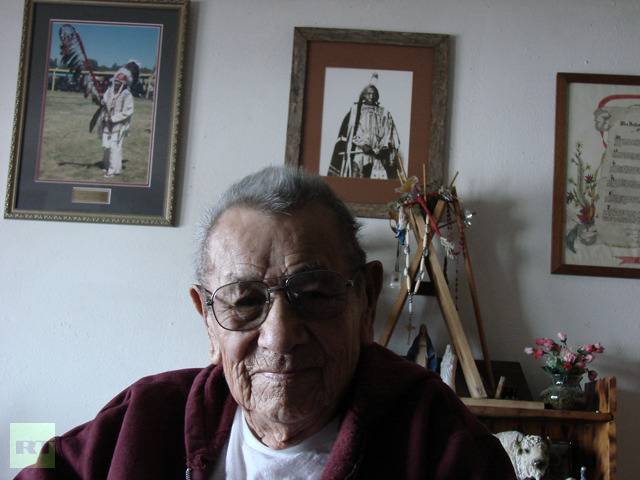

Chief Oliver, descendant of the legendary Chief Red Cloud, a supporter of Russell Means (Photo by Nadezhda Kevorkova)
RT: There’s a notion that Native Americans are now running casinos in their reservations, and making huge profits from them.
RM: Casinos are legalized robbery. Only weak-minded and weak-spirited would want to spend their time playing in them. There won’t be any casinos in the Republic of Lakotah. We don’t want people to be robbed under a pretext that this kind of business is profitable for a tribe.
RT: What kind of difficulties do you expect to face, such as traveling outside the U.S. without a passport?
RM: A passport is required to be able to return to your home country. You only need an ID within the country; and the same applies to Europe. People will need their Lakotah passports to travel the world; this is something we’ve been working on now. As for me, I don’t expect any problems leaving the country; but they may want stop me from getting back in, that’s a possibility. It would be interesting if an American-born wouldn’t be allowed to return to his homeland. According to a UN convention, all groups of nationalities have the right to their own passports. So we are operating within international law.
RT: What is the meaning of freedom that Lakotah represents?
RM: Today the world lives by 17th-century values. That’s when the idea emerged that interests of an individual were protected by representative democracy. Few understand that a national government isn’t the most balanced kind of representation.
The strongest kind of representation is an association of communities where each community is a group of free citizens that guarantees their protection. The United States was intended as such a union of communities but they are no longer that way. They became an old-fashioned system of hierarchal governance.
The Republic of Lakotah will be designed on a communities principle based on consensus between them. Each community will have their own judges, law enforcement teams, and electoral councils. A community governed by its people doesn’t need police.
The patriarchal governance system is based on fear that produces various phobias. Men fear women, and women gain so much power that their identity gets modified. Refugees storm the state borders, and states protect their borders, maintain armies of prisoners, and practice torture and execution. The entire society is saturated with fear that’s been stirred up artificially. A patriarchal state believes in negative only, and expects negative only from its people. It was generated together with the market; and it made people its slaves.
A union of free communities is based on the principle of freedom rather than fear. A lot of people worldwide do realize it; this is why the Republic of Lakotah has so many supporters. If racists want to join us they are welcome to come here and live in a racist community. Freedom implies an opportunity to be an idiot and to live in a community of the likes.
RT: Native Indians aren’t represented in the U.S. Senate, or Congress, or the Supreme Court, are they?
RM: They aren’t, and they haven’t been throughout all these centuries. We intend making the U.S. government liable for the genocide of ethnic Indians. We’re now preparing paperwork to start a case at the International Court in The Hague. We are convinced that many countries will support our cause.
RT: Many journalists paint a picture of your program as a return to wigwams, fires and ritual dances, is it not true?
RM: Some would probably find this picture quite attractive, but this isn’t a possibility. We have to proceed from the reality. By returning our culture we mean using all the opportunities. I’ve traveled to Europe many times, and I’ve learned of various approaches to preserving the national culture. Back in the Soviet times, I visited Hungary, Bulgaria, Poland, and East Germany – everywhere except Russia and the Arctic region. So I can make comparisons between places. The United States doesn’t even have opportunities for culture; it is only focused on money and on those forms of culture that yield money. Any art that sells is the kind of art that generates profit. It’s a terrible fodder turned into a machine for generating profit.
What we see now is the world being Americanized, the profitability principle, expanded. It’s caught up even with Russia which is however trying to resist it. We don’t want to see any further Americanization, but are no revisionists either – we aren’t calling people to going back to the Stone Age, to isolation, to an ethnographic museum type of life. Or to perform paid rituals, a kind of a spiritual prostitution that’s been involving Indians under the pretext that this is our way to preserve our identity by publicly performing our sacred dances.
So they say, if you don’t like Columbus, and progress, and democracy, you should give up using electricity, and computers, and phones. This is exactly what we will do immediately, as soon as those strangers and immigrants get on their boats and go back to their countries.
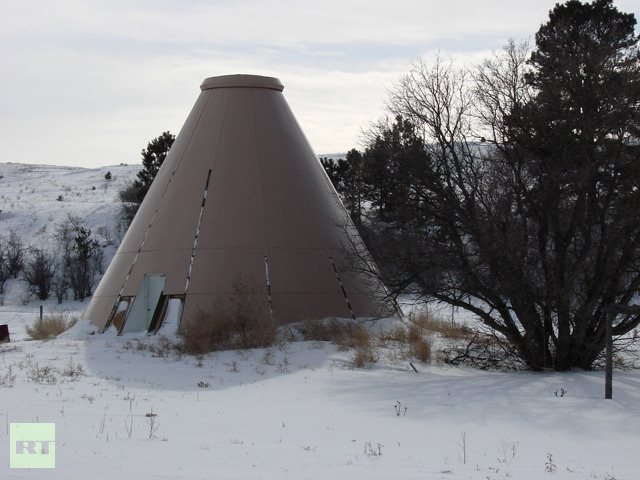
One of Russell Means’ achievements: A school for Native American children in Pine Ridge Reservation, South Dakota (Photo by Nadezhda Kevorkova)
RT:What do you have to offer instead of the pragmatic American system?
RM: We have a special group that’s developing a whole new system, from creating alternative energy sources to our own banks that won’t be robbing our citizens. You have no idea just how positive people are about Indians. This is something I felt quite strongly in my travels – they were positive about me just because I was an ethnic Indian rather than an American. With this kind of trust credit, we will overcome all our difficulties, together with our allies.
The governments will have to recognize us and give us sovereignty. Their laws say it’s our land. If they refuse to do so, we will file a suit to the Supreme Court. They will have to make that decision – you know they keep talking about the supremacy of law. Now it will backfire. So far they’ve been trying to ignore us, with the American press marginalizing us. But now, with the advent of the internet, these tricks have stopped working. The best idea for them would be to sit down and negotiate. Otherwise our next step would be going to the International Court in The Hague and demanding that genocide against American Indians be recognized. And we hope that as a founder of this court, Russia will support us.
Gandhi once said: First they ignore you, then they laugh at you, then they fight you, then condemn you, then you win.
RT:  Vladimir Putin also holds Gandhi in high esteem. He says that after Gandhi died, there is no one to talk to.  You have something to build upon.
RM: Putin was talking of the double-standard democracy in America. The US supports the sovereignty of all peoples, save for those who live in the US. So we are certain Russia will back us. There’s more on this. China’s resources are now worth around 40% of what the US has. Few people at all know that China has promised Bush a market collapse if the US attacks Iran. So there is a variety of tools for peoples to support one another.
RT:  What if special services assassinate you?
RM: We the Indians are not afraid of death.  And I haven’t been, either. Thirty-four years ago at Wounded Knee we defeated a whole army of special services. We will defeat it now, too.
You know the best thing about the Republic of Lakotah people? For centuries they slaughtered us, sacrificed us, fenced us into reservations, and stole our land, our air, our water. But we survived! We have things to offer. By contrast, they have nothing to offer. So they pretend we are non-existent.
RT:  What are your arguments against the US government?
RM: According to the US data, when Europeans came here, there were around 12 million Indians across 48 states. By the early 20th century, only 250,000 Native Americans survived. About 70% of Indians are refugees in their own country; they have been displaced from their own land. The US carried out an unparalleled genocide: they killed 99.6% Indians.
The US takes pride in its commitment to law and democracy. But throughout the years, there has been no respite in wars. There are only two countries in the world that keep breaching international law non-stop: the US and Israel. The US goes as far as neglecting its own constitution, which says that we are all free and can declare independence any time.
Right now the Republic of Lakotah is a five-state area. Six more have already supported us and would like to join us, too.
RT: Do you want to stick to peaceful means? And if it doesn’t work out, will you take up arms?
RM: Never. This is inefficient. If you want to fight your way to freedom, you are no different from your enemies. You can’t protect your independence by throwing swords into the scale. Look at the Soviet experience: it was a failure.

http://www.whale.to/a/native_americans1.html

Saturday, December 19, 2015

            Tempests, Gods and Devils

Danilo Anton

The invaders came from the East. They arrived in large ships and occupied the Taino, Carib, Ciboney and Guanatabey Islands. They seized lands and peoples. From the summits of her mountains, Amerrique witnessed their arrival
Eighty-eight days had passed and the terrible storm had not left us. I did not see the sun or the stars....my vessels were taking water....the sails torn...people very ill... frequently confessing one another...” Then “The storm came back... for nine days I was lost without hope. Never had eyes beheld the sea so high, ugly and foamy... I paused on that sea turned to blood, boiling like a cauldron over a great fire. Never had the sky been so awful. One day the night burned like an oven and threw flames of lightning ... so furious and frightening that all believed the vessels would be melted...” and the fatigue was so great “... that in some the heretical idea took hold that we were under a spell”
I am lost.... Isolated in this sorrow, ill, awaiting death every day and surrounded by a million savages, full of cruelty, and our enemies. I do not have a single hair that has not turned grey and my body is sick and worn out.... weep for me whomsoever feels charity, truth and justice.”
Christopher Columbus, Admiral of the Ocean-Sea had arrived in Amerrique, the “Land-Where-the-Wind-Blows”.
Amerrique was not only the land of the wind, she was also the Rich Coast, the Costa Rica, or as they say in a local native tongue: Huzgalpa or Huigalpa, the Country of Gold.
Columbus, Vespucci and other Europeans who arrived at her shores were attracted by the shining metal, the abundant gold, originating in the many mines o the interior.
The Admiral himself would say in his Diary of the Fourth Trip:
The gold is excellent, treasures are made from it, whomsoever has it can do as he pleases in the world and can send souls to Paradise”.
From "The Fraud of the Millenium", Danilo Anton, Piriguazu Ediciones
 Blog in Spanish:   daniloanton.blogspot.com

Thursday, December 17, 2015

Teonanacatl, the sacred mushrooms of Mexico
 Danilo Anton
The sacred mushrooms of Mesoamerica or teonanacatl are a set of psychoactive species mainly from the genus Psilocybe, but also from Conopcybe, Panaeolus and Stropharia.
They grow in most of Mesoamerica, and more especially in the territories of the states of Oaxaca, Campeche, Chiapas and Tabasco in Mexico and Guatemala.
The most commonly   species is Psilocybe caerulescens with a height that rarely exceeds 10 cm. Their shape is bell shaped, about 0.5- 3 cm in diameter and straw-colored, sometimes slightly greenish and even reddish brown. Psilocybe caerulescens grows given in altitudes of about 1400-1600 meters, mainly in limestone regions, under forest, in wet meadows and among mosses.They are highly psychoactive.
There are several species of the same genus with similar properties: Psilocybe mexicana Psilocybe semperviva Psylocybe yungensis Silocybe wassonii and Psilocybe hoogshagenii.
Other species of psychoactive mushrooms consumed  by traditional Mesoamerican societies are Panaeolus sphinctrinus, reaching 10 cm in height, growing on cow dung, Stropharia cubensis (called "Sanisidro", about 4 to 15 cm tall, tan, and also grows in manure), and Conocybe siligineoides (reddish brown, about 8 cm in height growing on rotten wood).
The effect of these fungi is mainly due to the presence of a psychoactive alkaloid psilocybin. Many possess also psilocin, a compound which can enhance the effect of the first.
Mazatec and other peoples in neighboring regions coasumed it for a long time to get  visions and wisdom to heal the sick, or to make decisions about life.

Historical Reference

References to the Spanish chroniclers teonanacatl are very partial and therefore they can not be taken at face value. Rather, we must use the knowledge on the current use of the fungus. and use a little common sense to rebuild the role that these drugs had in Native American populations.
Sahagun says that "Indians" were eating them in a black fungus called nanacatl , that got ​​them drunk and hallucinating. They were ingested with honey to obtain visions of various kinds (usually disastrous), they began to dance or sing or mourn, or simply remain thoughtful. 
Francisco Hernandez in his Historia Plantarum Novae Hispaniae describes the habit of eating mushrooms as follows:
"Others are eaten when they do not cause death but cause sometimes.... a kind of irresistible hilarity. They are commonly called Teyhuinti. They are tawny color and bitter taste and they have a certain freshness that is not unpleasant. Others, without provoking laughter, generate visions of all kinds .... . "
 Motolinía, meanwhile, gave his own version:
otherwise they got a kind un drunkness that made ​​more cruel: it was with some small mushrooms, which in this earth they look as in Castile; more so that in this land are of such quality, because when they are eaten raw they are bitter, they eat them with a little honey; aftere what they see thousand visions, especially serpents ... They are called teunanacatl which in their language means  flesh of God or the Devil. They worship them and that way with that bitter delicacy their cruel God.commuted them."   
 Today teonanacatl is still widely consumed in native cultures of Oaxaca, Chiapas and other Mexican states and Guatemala, and even there are people from North America and Europe who come to have the "teonanacatl experience".
Continue in next postings.
From the book "Peoples, Drugs and Serpents", Danilo Anton, Piriguazu Ediciones.