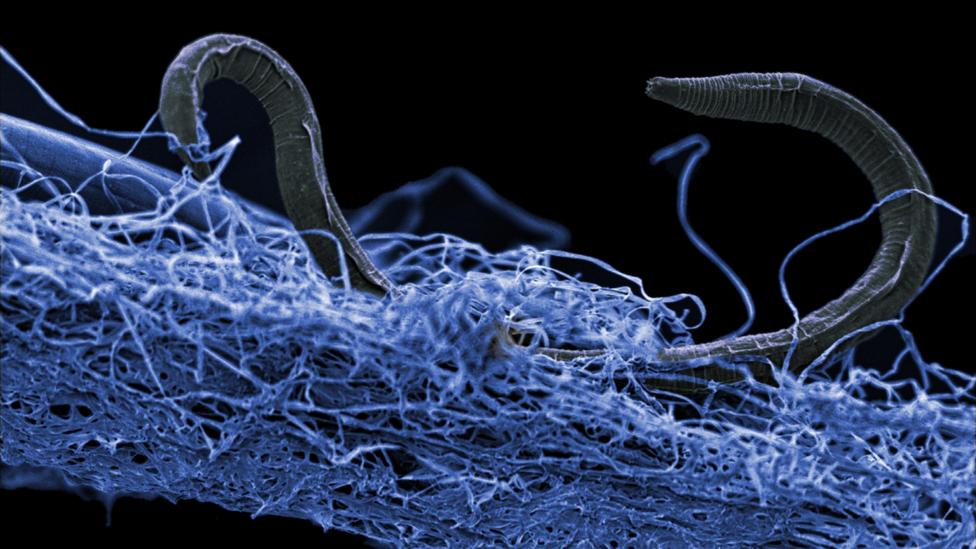
Life underground. Here I include some references from BBC site referring to undeerground organisms. Particularly I want to show the importance of this geologic biota. In next posting I will include an article on hyperthermobacteria.
The strange beasts that
live in solid rock deep underground
By Jasmin Fox-Skelly
24
November 2015
Drill
down a mile or two into Earth's crust and you will find solid rock,
unbearable heat and little oxygen. Yet it turns out there is also
thriving animal life
Just
how far down in the Earth's crust can animals survive? In the dark,
hot depths of several South African gold mines, there live some tiny
worms that may hold the key to answering that question.
These
creatures are the deepest living animals that have ever been
discovered.
No
one knows how they got down there, but they could have been living in
the mines for thousands of years. Their very existence suggests that
complex life can survive far deeper in the Earth than was ever
thought possible.
In
the 1980s, scientists discovered that life
can endure thousands of feet beneath the Earth's surface.
Nematodes can transform into a special form called the dauer stage
However,
most scientists believed that the bowels of the Earth could only
house single-celled organisms like bacteria. In the deep Earth it is
hot and dark, and there is very little oxygen. There is also not much
food down there, so any animal making its home in the belly of the
Earth would struggle to get a decent meal.
One
scientist thought differently. Gaetan
Borgonie was
previously at the University of Ghent in Belgium and is now at
Extreme Life Isyensya in Gentbrugge, Belgium. He was convinced that
one animal could survive deep down in the Earth's crust: a nematode
worm.
That
is because nematodes are extremely hardy, able to cope with extreme
heat, cold and dehydration. They have an ingenious trick that allows
them to survive.
Nematodes
can transform into a special form called the dauer stage.
In this form, they can survive harsh conditions for long periods
before reawakening when the going gets good again.
Surely if any animal could live deep inside the Earth it would be this hardy worm?
This
makes them similar to tardigrades: tiny creatures that can survive
being boiled,
frozen, crushed, dried out or blasted into space by
going into a kind of stasis.
In
the dauer stage, the nematode goes into stasis and its metabolism
slows. The stage is triggered by a pheromone and occurs when there is
a lack of food, high temperature, or overcrowding.
Nematodes
in the dauer state are spectacularly resilient. When
the space shuttle Columbia broke up after re-entering Earth's
atmosphere in 2003,
there were nematodes on board: they
survived both the disintegration and the fall back to Earth.
Nematodes
have populated almost all areas of the world. They can be found in
hot springs, deserts, high up mountains and in the deepest oceans.
They live in Antarctica, inside the bellies of other animals
including humans, and even inside
the placentas of sperm whales.
Surely if any animal could live deep inside the Earth it would be
this hardy worm?
Borgonie
decided to look for himself, but sceptical grant holders denied him
funding. So he teamed up with Tullis
Onstott of
Princeton University in New Jersey, who also believed that nematodes
could exist deep underground. The pair used money from their own
savings to travel to South Africa.
Before this, nematodes were only known to live a few dozen feet underground
They
chose South African mines because they are the deepest accessible
places on Earth. Ore miners have drilled to depths of more than 2
miles (3.2km), so researchers can access Earth's hidden subterranean
world.
Borgonie
began searching the hot and humid mines for life. He took samples of
water pouring from boreholes, which had previously been drilled into
the rock by mine geologists to check for gas and water pockets ahead
of mining operations. He then filtered the water, searching it for
life.
When
he looked under a microscope he found lots of little worms, the first
animals discovered this deep underground. Before this, nematodes were
only known to live a few dozen feet (tens of metres) underground.
This
video shows the conditions in which the nematodes are living.
The
next step was to show that the worms originated in the mine, and had
not been accidentally brought in on miners' shoes or through other
contamination. To do this, Borgonie spent a year testing 8,343
gallons (31,582 litres) of water used in mining operations. He also
searched the soil near the boreholes.
Borgonie did not just find one species of worm: he found four, living in three separate mines
He
found no worms in the mining water, demonstrating that the nematodes
were not coming into the mine from above. The nematodes in the soil
belonged to different species. He also demonstrated that the worms
preferred to munch on the bacteria that live in the mine, rather than
bacteria from outside, which suggested that the worms were
well-established in the mine.
"When
you go underground the pressure increases, the temperature increases,
oxygen diminishes and food becomes scarcer," says Borgonie.
"Therefore one assumed that looking for multicellular life was
akin to bonkers."
Yet
Borgonie did not just find one species of worm: he found four, living
in three separate mines.Two species – Plectus
aquatilis and
an unknown nematode – were found in the Driefontein
mine at
a depth of 0.6 miles (0.9 km) at 24 °C.
They
were topped by Halicephalobus
mephisto,
a new species of nematode. It was found living in the Beatrix
gold mine,
150 miles (240 km) south-west of Johannesburg. The worm was living
0.8 miles (1.3 km) underground. At such depths the temperatures reach
37 °C, hotter than most terrestrial nematodes can survive.
The worms feed on snotty layers of goo called biofilms
At
the time, many media outlets described H.
mephisto as
the deepest-living animal known, or at least gave the impression that
it was. But it was nothing of the sort.
The
DNA of another unknown species was found in water 2.2 miles (3.6km)
down in the TauTona mine, where temperatures are around 48 °C. This
mystery species was the deepest-living animal ever. "Because H.
mephisto got
all the attention, it stuck that 1.3km was the deepest, but it
isn't," says Borgonie.
What's
more, according to Borgonie the nematodes are not simply eking out a
marginal existence underground. They are thriving.The worms feed on
snotty layers of goo called biofilms, which consist of millions of
bacteria stuck together. Each bacterium is 10 billion times smaller
than the worm. The gooey biofilms have attached themselves to the
man-made boreholes. This suggests that, by mining the rocks for gold,
humans have inadvertently created the perfect habitat for the worms.
P. aquatilis is a common freshwater nematode
The
low oxygen levels do not bother the worms. Whilst humans need their
air to contain 21% oxygen, nematodes are not so picky and can do just
fine with as little as 0.5%.
The
hot temperatures are also not a problem. Even the 48 °C heat of the
TauTona mine is nothing to some species of nematodes, which have been
found in hot springs reaching 61 °C.
It
seems the worms had already evolved to withstand heat and crushing
pressure, long before they entered the mines.