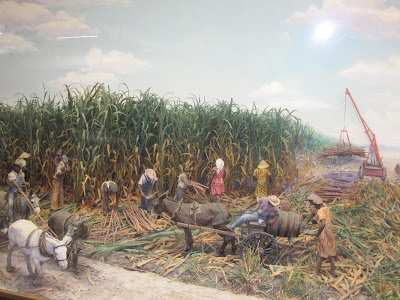
Showing posts with label Sugar. Show all posts

Wednesday, April 3, 2019

Sugar, spirits and slavery in America
It is known that the "discovery" of America had to do with the search for a commercial road to Southeast Asia, in the face of the obstruction of the traditional roads of the Middle East that at that time had fallen under Turkish rule. It is also known that the medieval culture of the time had generated a mythology of great wealth in distant countries, travelers or knights who after countless adventures managed to become of great wealth and power. Spaniards and Portuguese came to this continent, unknown to them, looking for spices and gold but finally the main motivation for their conquest was the cultivation of sugarcane.
Sugar cane was domesticated in India, arriving in the Iberian Peninsula in the 12th century to be introduced in the Madeira Islands and then Santo Tomé during the 15th century by the Portuguese, where it was intensively cultivated using Guanche slave labor from of the Canary Islands recently occupied by blood and fire by the Castilian and African kings brought from the Guinea coasts.
Sugar in Europe was substituted for honey and already in the 12th and 14th centuries it was sold in the shops. At the same time the distillation was developed, giving rise to the production and consumption of the spirits that increased the demand and therefore the production of sugarcane.
The highest yields were achieved in Madeira and Santo Tomé. At the end of the 1450s Madeira sugar was sold in London. In 1493 there were eighty mills producing eighteen tons a year.
The huge profits obtained from the sale of sugar in Europe allowed the Portuguese and their Spanish partners to finance further expeditions, including those that would culminate in the conquest of the American continent.
In all the appropriate places, both Spaniards and Portuguese established sugarcane plantations using for it the slave labor of the natives who inhabit these countries. The Spanish enslaved tens of thousands of Tainos and Caribs in the islands they controlled (Haiti, Cuba, Puerto Rico, etc.) and the Portuguese did the same with populations Tupinikin, Carijo, Tupinambá, Caeté and others in the coast of Brazil.
The elimination of the original indigenous population of these sugar regions took place very quickly. The Taínos of Cuba and Haiti were reduced from millions to hundreds in less than half a century, some of the Lesser Antilles were emptied into three or four kidnapping expeditions. The Portuguese acted similarly in their dominions of Brazil by eliminating the First Nations of the entire northeast coast from Ceará to Ilheus in little more than fifty years. The carijá and other groups of the southern coasts, around the colonies of Sao Paulo and Sao Vicente, ran the same fate. At the beginning of the seventeenth century, Spaniards and Portuguese had killed directly or indirectly more than 10 million people, depopulating vast regions and hindering the development of the same productive activities that were based on the work of these populations.
Thus the islands of the Caribbean and the coasts of Brazil were emptied, regions densely populated in times previous to the invading influence. The lack of labor that they themselves had caused ended up causing great concern among the Spanish and Portuguese settlers who no longer had indigenous slaves to exploit in the plantations, sugar mills, mines and various services. As a result, more and more slaves captured on African lands began to be used more and more to fulfill the tasks that the eliminated indigenous could no longer fulfill.
The slave trade was an ancient and sad history in Africa since ancient times. The successive Moroccan kingdoms of the Maghreb and the Sultanates of the Arabian Peninsula and the coasts of the Indian Ocean were dedicated to the slave trade from the 11th and 12th centuries. This traffic was destined to the Mediterranean and European kingdoms and empires of the time in exchange for metals, fabrics and other manufactured products. Many of the slaves thus incorporated into the market were of African origin, but not exclusively. The successive wars allowed to capture slaves of many geographic and ethnic origins. During the 12th to 15th centuries the wealthy and "elite" classes of the countries of Western Europe and the Muslim countries of the Mediterranean had become "accustomed" to using African slaves, generally from the territories of West Africa and Guinea. According to Herbert S. Klein it is estimated that between 5,000 and 10,000 slaves per year traveled the route between Sub-Saharan Africa and the countries of the Mediterranean and Europe. This implied that at the end of the six centuries before the arrival of the Portuguese in West Africa no less than 3.5 million Africans were "exported" out of Africa.
The Portuguese and their local subordinates were the first to enter the continent from the sea with slave ends. They had their bases of operations were in the islands of Cape Verde and Sao Tome. By the end of the sixteenth century, they had established themselves firmly in the population of San Salvador in the Congo, where merchants and adventurers involved in slave trade were constantly arriving.
The numbers of exported slaves grew regularly. In the 18th century, approximately 16,000 Africans arrived each year in the ports of Brazil, Rio de Janeiro and Salvador de Bahia. In the second decade of the following century this number had increased to 40,000.
As they strengthened economically, demographically and technologically, other European states began to get involved in the slave trade to nourish their own American colonies. The English to supply their plantations in the Caribbean, Jamaica, Trinidad, Barbados and others. To meet this trade, British ships were following triangular routes: leaving the slaves in Jamaica, returning to England carrying sugar, coffee, indigo and cotton, and then returning to Africa laden with textiles, metal utensils, gunpowder, firearms and alcoholic beverages. . In addition to traffic to the Caribbean, the English also transported slaves to Buenos Aires and Montevideo (in 25 years a total of 16,000), a portion of which were transported to Upper Peru.

The introduction of African slaves in small numbers in America began very early, probably before 1502 when Governor Ovando de la Española unsuccessfully requested the suppression of such shipments. In 1520 the Spanish settlers of Puerto Rico where the natives had been practically exterminated began to acquire African slaves in considerable numbers for their plantations and mills. In the following years the colonists of the other islands also began to buy slaves of that origin to compensate the lack of natives. At that time the Royal Officers of Santo Domingo informed King Charles V that there had been an increase in the price of African labor: "The blacks have risen to a high price because they only work, none Spanish. We beg for a general remedy for all the Indies at said price and that the Indians of Brazil from Portugal may enter (as slaves) to this island. "

Friday, December 29, 2017

Sugar,  hard liquors and slavery

It is known that the "discovery" of America had to do with the search for a commercial road to Southeast Asia, in the face of the obstruction of the traditional roads of the Middle East that at that time had fallen under Turkish rule. It is also known that the medieval culture of the time had generated a mythology of great wealth in distant countries, travelers or men who after countless adventures managed to make themselves of great wealth and power. Spaniards and Portuguese arrived in this continent, unknown to them, looking for spices and gold, but finally the main motivation for their conquest was the cultivation of sugarcane.
Sugarcane was domesticated in India, arriving in the Iberian Peninsula in the 12th century to be introduced in the Madeira Islands. and then Santo Tomé, during the 15th century by the Portuguese, where it was intensively cultivated using guanche slave labor. coming from the Canary Islands recently occupied by blood and fire by the Castilians, and from the coasts of Guinea. 
Sugar in Europe was a substitute for honey and already in the 12th and 14th centuries it was sold in the pharmacies. At the same time the distillation was developed, giving rise to the production and consumption of the spirits and hard liquors that increased the demand and therefore the production of sugarcane.  The highest yields were achieved in Madeira and Santo Tomé. At the end of the 1450s Madeira sugar was sold in London. In 1493 there were eighty mills producing eighteen tons a year.
The huge profits obtained from the sale of sugar in Europe allowed the Portuguese and their Spanish partners to finance further expeditions, including those that would culminate in the conquest of the American continent.
In all the appropriate places, both Spanish and Portuguese established sugar cane plantations using the slave labor of the natives who inhabited those countries. The Spanish enslaved tens of thousands of Tainos and Caribs in the islands they controlled (Haiti, Cuba, Puerto Rico, etc.) and the Portuguese did the same with populations Tupinikin, Carijo, Tupinambá, Caeté and others on the coast of Brazil.
The elimination of the original indigenous population of these sugar regions took place very quickly. The Taínos of Cuba and Haiti were reduced from millions to hundreds in less than half a century, some of the Lesser Antilles were emptied after three or four kidnapping expeditions. The Portuguese acted similarly in their domains of Brazil by eliminating the First Nations of the entire northeast coast from Ceará to Ilheus in little more than fifty years. The Carijá and other groups of the southern coast, around the colonies of Sao Paulo and Sao Vicente, ran the same fate. At the beginning of the seventeenth century, Spaniards and Portuguese had killed directly or indirectly more than 10 million people, depopulating vast regions and hindering the development of the same productive activities that were based on the work of these populations.
This is how the islands of the Caribbean and the coasts of Brazil were emptied, regions densely populated in times previous to the invading influence. The lack of labor that they themselves had caused ended up causing great concern among Spanish and Portuguese settlers who no longer had indigenous slaves to exploit in plantations, sugar mills, mines and various services. As a result, they began to resort more and more frequently to slaves captured in African lands to fulfill the tasks that the eliminated indigenous could no longer fulfill.

Slave trade was an ancient and sad history in Africa since ancient times. The successive Moroccan kingdoms of the Maghreb, the Sultanates of the Arabian Peninsula and the coast of the Indian Ocean were dedicated to the slave trade from the 11th and 12th centuries. This traffic was destined to the Mediterranean and European Kingdoms and Empires of the time in exchange for metals, fabrics and other manufactured products. Many of the slaves thus incorporated into the market were of African origin, but not exclusively. The successive wars allowed to capture slaves of many geographic and ethnic origins. During the 12th to 15th centuries the wealthy and "elite" classes of the countries of Western Europe and the Muslim countries of the Mediterranean had become "accustomed" to using African slaves, generally from the territories of West Africa and Guinea. According to Herbert S. Klein it is estimated that between 5,000 and 10,000 slaves per year traveled the route between Sub-Saharan Africa and the countries of the Mediterranean and Europe. This meant that at the end of the six centuries prior to the arrival of the Portuguese in West Africa no less than 3.5 million Africans were "exported" out of the continent57. Caravans carrying various goods and slaves used the trans-Saharan route. At a time when these routes were controlled by Moroccans, the infamous trade originated in certain gangs of kidnappers organized from certain populations of the Sahel, specialized in this traffic, including the Tuaregs, the Fulani and other groups from the Saharan shore. Several kingdoms of this area were based largely on such trade (as Gana, Mali and the Empire of Gao in the twelfth to fourteenth centuries). When the Portuguese arrived in the fifteenth century by sea (ie by the south) the relationship was reversed. As of that moment the task of "capture" was in the hands of the coastal populations and those attacked were the peoples of the interior.
As a result of these readjustments of commercial circuits and the conquest of African bases, Portugal managed to seize the slave trade. In the fifteenth century the Portuguese occupied the Atlantic islands (Cape Verde, Azores and Santo Tomé) and several coastal bases in the Gulf of Guinea and began to exploit the sugarcane using slave labor
Since 1576, when the Portuguese settled in the Sao Paulo neighborhood of Luanda, the traffic moved to this colony, producing an important increase in the numbers exported. The trade of Angola and the coast of Mina (Dahomey) was organized especially in the sugar areas of Brazil and Guinea more oriented to Cartagena de Indias and Peru. 
The ports of the Río de la Plata, later founded, received slaves from Angola and Mozambique on the east coast of the continent.
Despite the antiquity of the slave trade in Africa, when the first Portuguese arrived, many coastal towns in western Africa ignored the origin and purposes of the newcomers. These pale men were simply "murdele" (men of the sea).
There are traditional versions that show the surprise of Africans before the arrival of Europeans:
«They saw a large vessel appear on the wide sea. This boat had white wings shining like knives. White men came out of the water and said words that no one could understand. Our ancestors were afraid, they said they were Vumbi, ghosts of the dead. They were thrown back into the sea with their arrows. But the Vumbi spat fire with a sound of thunder.
From that moment the looting is triggered. A King of the Congo commented: "Thieves and men without conscience arrive at night to take away the children of our nobles and vassals, tempted by the desire to possess the goods and merchandise of the Portuguese." Garcia de Resende said in 1554: « there are many merchants who specialize in this and deceive them and deliver them directly to the slave traders. "
The Portuguese slave trade that dominated commerce during the sixteenth and seventeenth centuries was based on a chain of forts that had been established along the entire African coast. From the seventeenth century the English appeared through the English Royal Africa Company and the French with their Compagnie du Sénégal which in 1717 was absorbed by the Company of the French Indies.

The Portuguese and their local subordinates were the first to enter the continent from the sea with slave ends. They had their bases of operations were in the islands of Cape Verde and Sao Tome. At the end of the sixteenth century, they had firmly established themselves in the population of San Salvador in the Congo, where merchants and adventurers involved in slave trade were constantly arriving.
The numbers of exported slaves grew regularly. In the 18th century, approximately 16,000 Africans arrived each year in the ports of Brazil, Rio de Janeiro and Salvador de Bahia. In the second decade of the next century this number had increased to 40,000.
As they strengthened economically, demographically and technologically, other European states began to get involved in the slave trade to nourish their own American colonies. The English to supply their plantations in the Caribbean, Jamaica, Trinidad, Barbados and others. To meet this trade, the British ships had triangular itineraries: they left the slaves in Jamaica, returned to England carrying sugar, coffee, indigo and cotton, and then returned to Africa loaded with textiles, metal utensils, gunpowder, firearms and alcoholic beverages. . In addition to the traffic to the Caribbean, the English also transported slaves to Buenos Aires and Montevideo (in 25 years a total of 16,000), a part of which were transported to Upper Peru.
The introduction of African slaves in small numbers in America began very early, probably before 1502 when Governor Ovando de la Española unsuccessfully requested the suppression of such shipments. In 1520 the Spanish colonists of Puerto Rico where the natives had been practically exterminated began to acquire African slaves in considerable numbers for their plantations and mills. In the following years the colonists of the other islands also began to buy slaves of that origin to compensate the lack of natives. At that time the Royal Officers of Santo Domingo informed King Charles V that there had been an increase in the price of African labor: "The blacks have risen at a high price because they only work, none Spanish. We pray for a general remedy for all the Indies at said price and that the Indians of Brazil from Portugal may enter (as slaves) on this island. "

From "Amerrique, the Orphans of Paradise", Danilo Anton, Piriguazù Ediciones


Wednesday, August 2, 2017

A sweet addiction
Danilo Anton 

Sugars are organic substances that develop as a result of photosynthesis and plant metabolism, they are an essential element of the sap of plants, and are present in the honey produced by certain Hymenoptera such as bees and wasps.
The main compounds of sugar are sucrose, glucose, dextrose, fructose, levulose, lactose and maltose.
Sucrose or sucrose (C12 H22 O11 ), or “common”sugar  is the most consumed in contemporary societies.   It melts at 185 °C, and when cooled, after reaching 200 ° C, it becomes caramel. Common sugar is obtained as a byproduct of numerous plants3   among them sugar cane and in a lesser degree sugar beet.
Corn is also used as a source of sugar, but the resulting compounds are especially glucose and dextrose.

Sugar, the industrial drug
Sugar is the most widely used drug in the contemporary world. However, his name is usually absent from discussions on contemporary addictions.
Sugar intake produces a brief physiological”acceleration”, followed by depression and guilt. When it is consumed for prolonged periods results in a moderate addiction, which, while relatively safe at first, over time may become intense and harmful to health. Commonly sugar addiction does not occur in isolation but its addiction is combined with other substances, such as caffeine.

Some addicts consume “diet” sweetener pills instead of sugar, but then, to mitigate the symptoms of lack of sugar, they end up ingesting tranquilizers.
There is also a proven link between sugar and alcohol consumption. There is a tendency for both addictions to be combined and mutually reinforcing.

Sugar-products
While it is a globally spread substance, sugar is a relatively new product. In the Greco-Roman times it was not known. In these cultures the main sweetener was honey which was used as food dressing, and for ceremonial purposes. In Africa and America, as in Europe, honey was historically the main sweetener.
The traditional sugar consumption was limited for a long time to the place of origin of sugarcane, India. There it was used since ancient times as an important component of local diets.
The advance of sugar cane cultivation was slow. From India it spread to Egypt in the eighth and ninth centuries dec. From there ir expanded West.
In medieval Europe sugar was sold in pharmacies, in small quantities and high prices, and consumption was mainly considered for medicinal purposes.
With the advancement of the Muslim civilization, sugar cane cultivation spread to North Africa and finally to Andalusia, in Islamic Spain. 
Indeed, one of the reasons that fueled the economic boom of the Caliphate of Córdoba and other Arab kingdoms of the Iberian peninsula was the production and export of sugar.
Muslin Cordoba fell in 1236, then Sevilla (1248) and finally Granada in 1492. The sugarcane crops of Spain were taken over by the Christian kingdoms which had been the victors of the long war.
The nascent Iberian empires would skillfully exploit this new crop which provided lucrative returns. In the first instance, to continue cultivating sugar cane, cane was planted in Andalucia and Portuguese Alentejo and Moor captives were used as slaves  
Later, as transoceanic expansion of the kingdoms of Castile, Aragon and Portugal progressed Guanche and African slaves were used.
When the new possessions were firmly under control  plantations began to be installed in the conquered territories.
From: "Peoples, Drugs and Serpents". Danilo Anton, Piriguazú Ediciones.


Friday, April 21, 2017


Sugar, a typical drug of modern societies


D,Anton
While it is a globally spread substance, sugar is a relatively new product. In the Greco-Roman times it was not known. In these cultures the main sweetener was honey which was used as food dressing, and for ceremonial purposes. In Africa and America, as in Europe, honey was historically the main sweetener.
The traditional sugar consumption was limited for a long time to the place of origin of sugarcane, India. There it was used since ancient times as an important component of local diets.
The advance of sugar cane cultivation was slow. From India it spread to Egypt in the eighth and ninth centuries dec. From there ir expanded West.
In medieval Europe sugar was sold in pharmacies, in small quantities and high prices, and consumption was mainly considered for medicinal purposes.
With the advancement of the Muslim civilization, sugar cane cultivation spread to North Africa and finally to Andalusia, in Islamic Spain. 
Indeed, one of the reasons that fueled the economic boom of the Caliphate of Córdoba and other Arab kingdoms of the Iberian peninsula was the production and export of sugar.
Muslin Cordoba fell in 1236, then Sevilla (1248) and finally Granada in 1492. The sugarcane crops of Spain were taken over by the Christian kingdoms which had been the victors of the long war.
The nascent Iberian empires would skillfully exploit this new crop which provided lucrative returns. In the first instance, to continue cultivating sugar cane, cane was planted in Andalucia and Portuguese Alentejo and Moor captives were used as slaves  
Later, as transoceanic expansion of the kingdoms of Castile, Aragon and Portugal progressed Guanche and African slaves were used.
When the new possessions were firmly under control  plantations began to be installed in the conquered territories.

The Madeira Triangle

Since the end of the fourteenth century the Portuguese had visited an uninhabited forested island that was a few days of sailing southwest of Lisbon. They called it “Madeira”. In 1420 the island was occupied by an expedition led by Portuguese navigator Gonçalves Zarco.
As the island had a humid subtropical climate suitable for growing sugarcane., The Portuguese decided to use it to extend their Alentejo plantations to a more productive territory.
As a first step, the Portuguese set out to burn the island forests and in their place they established sugar plantations and mills. It is said that the burning of Madeira forests lasted seven years.
Cane plantations require abundant labor and the island itself did not have native population.  The problem was solved in the same way that was done in Portugal, through the use of slave labor.
At that time the Spanish kingdom was in full conquest of the Guanches (or Canary) Islands close to Madeira. As a result of the conquest wars they had captured numerous slaves that were used for forced labor. Some of them remained in the Canary Islands,  and the rest was sent to Madeira and Andalusia to occupy in the sugar agricultural work.
The Spaniards took advantage of this to sell many guanches captives to the Portuguese, and thereby achieve significant additional income. So “the triangle of Madeira” was defined. Most of the sugar was produced in Madeira, the market was in Europe and the labor was provided (sold) by Spain.
The high value of sugar on the European market allowed Portugal to accumulate much of the wealth obtained, and thanks to it this Kingdom was able to finance both the conquest of Africa and Brazil. In turn, indirectly, Spain also achieved huge profits by selling Guanche slaves, captive Moors and its own sugar cane production was added in order to obtain the necessary resources that would allow him to pay the costs of the American adventure.
Some years later, after 1492 (the beginning of the Spanish conquest of the Taino countries in the Caribbean), and 1499-1500 (arrival of the Portuguese in Brazil), both kingdoms began setting up extensive plantations of sugarcane using the Madeira Island model. In the same way that they did in the Atlantic islands, they subjected native American populations of Taino and Tupi occupied territories to cruel treatment, crushing their resistance with blood and fire, as it had happened in the Guanches islands After the conquest they caught, used or sold all the slaves they could.
As a result of these westward European invasions riding the new horse of the apocalypse, Spain and Portugal would produce one the greatest genocides in history: the slaughter of over two million people in the Caribbean islands, carried out by the Spanish invaders, and the death of hundreds of thousands of natives in Brazil, done by the Portuguese.
These great abuses on human dignity were executed to ensure the increased production and earnings with this new product The story did not end there. 
Sugar was the main element of the Iberian colonial economies for long time. Its production spread along the Brazilian coast, the Caribbean islands, Central America and northern South America, to the island of Sao Tome, occupied by Portugal, in the Gulf of Guinea, and several African coastal territories .
Later, when the Spanish colonies in America and Brazil gained independence, they continued their economies tied to this deforming monoculture.After several centuries, the cultures of many countries are so sugar cane adapted that it very difficult to achieve significant diversification.
Industrialization determined that sugar was consumed worldwide. To a large extent, this was the consequence of increased cultivated areas.
For a not very long period, some countries sought independence from cane developing other sugar producing crops. Chief among them was the sugar beet which was utilized as a substitute in the era of agricultural and industrial protectionism.
Lately, and as trade barriers were demolished, beet producing countries abandoned their crops and cane again increased its predominance (which actually never completely lost).
Globalization also allowed other industrial derived sugars from other crops were used.  It is the case of glucose, dextrose and fructose syrups, obtained mainly from corn, and most especially dietary sweeteners, which are marketed as non calories sugar substitutes.

The new sweeteners

Refined sugar have caused serious dietary disorders in contemporary societies. Excessive consumption has caused problems of obesity, hypertension, heart, kidney, diabetes and other ailments, to a high percentage of the population. For that reason, substitutes were sought to reduce these risks without changing the  sweet “tastes” to which people had become accustomed.
As a result some artificial sweeteners quickly spread throughout the world. 
Several of them were harmful to health.  Some were banned (cyclamates), another one has been considered risky for human consumption (saccharin). Finally, a recently patented sweetener (aspartame) which is being consumed globally, appears to have serious drawbacks that could also restrict its marketing and utilization.
From Peoples, Drugs and Serpents, Danilo Anton, Piriguazu Ediciones