Showing posts with label Slavery. Show all posts

Wednesday, April 3, 2019

Sugar, spirits and slavery in America
It is known that the "discovery" of America had to do with the search for a commercial road to Southeast Asia, in the face of the obstruction of the traditional roads of the Middle East that at that time had fallen under Turkish rule. It is also known that the medieval culture of the time had generated a mythology of great wealth in distant countries, travelers or knights who after countless adventures managed to become of great wealth and power. Spaniards and Portuguese came to this continent, unknown to them, looking for spices and gold but finally the main motivation for their conquest was the cultivation of sugarcane.
Sugar cane was domesticated in India, arriving in the Iberian Peninsula in the 12th century to be introduced in the Madeira Islands and then Santo Tomé during the 15th century by the Portuguese, where it was intensively cultivated using Guanche slave labor from of the Canary Islands recently occupied by blood and fire by the Castilian and African kings brought from the Guinea coasts.
Sugar in Europe was substituted for honey and already in the 12th and 14th centuries it was sold in the shops. At the same time the distillation was developed, giving rise to the production and consumption of the spirits that increased the demand and therefore the production of sugarcane.
The highest yields were achieved in Madeira and Santo Tomé. At the end of the 1450s Madeira sugar was sold in London. In 1493 there were eighty mills producing eighteen tons a year.
The huge profits obtained from the sale of sugar in Europe allowed the Portuguese and their Spanish partners to finance further expeditions, including those that would culminate in the conquest of the American continent.
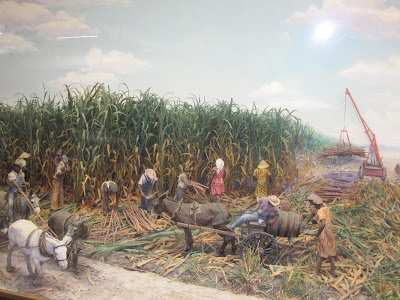
In all the appropriate places, both Spaniards and Portuguese established sugarcane plantations using for it the slave labor of the natives who inhabit these countries. The Spanish enslaved tens of thousands of Tainos and Caribs in the islands they controlled (Haiti, Cuba, Puerto Rico, etc.) and the Portuguese did the same with populations Tupinikin, Carijo, Tupinambá, Caeté and others in the coast of Brazil.
The elimination of the original indigenous population of these sugar regions took place very quickly. The Taínos of Cuba and Haiti were reduced from millions to hundreds in less than half a century, some of the Lesser Antilles were emptied into three or four kidnapping expeditions. The Portuguese acted similarly in their dominions of Brazil by eliminating the First Nations of the entire northeast coast from Ceará to Ilheus in little more than fifty years. The carijá and other groups of the southern coasts, around the colonies of Sao Paulo and Sao Vicente, ran the same fate. At the beginning of the seventeenth century, Spaniards and Portuguese had killed directly or indirectly more than 10 million people, depopulating vast regions and hindering the development of the same productive activities that were based on the work of these populations.
Thus the islands of the Caribbean and the coasts of Brazil were emptied, regions densely populated in times previous to the invading influence. The lack of labor that they themselves had caused ended up causing great concern among the Spanish and Portuguese settlers who no longer had indigenous slaves to exploit in the plantations, sugar mills, mines and various services. As a result, more and more slaves captured on African lands began to be used more and more to fulfill the tasks that the eliminated indigenous could no longer fulfill.
The slave trade was an ancient and sad history in Africa since ancient times. The successive Moroccan kingdoms of the Maghreb and the Sultanates of the Arabian Peninsula and the coasts of the Indian Ocean were dedicated to the slave trade from the 11th and 12th centuries. This traffic was destined to the Mediterranean and European kingdoms and empires of the time in exchange for metals, fabrics and other manufactured products. Many of the slaves thus incorporated into the market were of African origin, but not exclusively. The successive wars allowed to capture slaves of many geographic and ethnic origins. During the 12th to 15th centuries the wealthy and "elite" classes of the countries of Western Europe and the Muslim countries of the Mediterranean had become "accustomed" to using African slaves, generally from the territories of West Africa and Guinea. According to Herbert S. Klein it is estimated that between 5,000 and 10,000 slaves per year traveled the route between Sub-Saharan Africa and the countries of the Mediterranean and Europe. This implied that at the end of the six centuries before the arrival of the Portuguese in West Africa no less than 3.5 million Africans were "exported" out of Africa.
The Portuguese and their local subordinates were the first to enter the continent from the sea with slave ends. They had their bases of operations were in the islands of Cape Verde and Sao Tome. By the end of the sixteenth century, they had established themselves firmly in the population of San Salvador in the Congo, where merchants and adventurers involved in slave trade were constantly arriving.
The numbers of exported slaves grew regularly. In the 18th century, approximately 16,000 Africans arrived each year in the ports of Brazil, Rio de Janeiro and Salvador de Bahia. In the second decade of the following century this number had increased to 40,000.
As they strengthened economically, demographically and technologically, other European states began to get involved in the slave trade to nourish their own American colonies. The English to supply their plantations in the Caribbean, Jamaica, Trinidad, Barbados and others. To meet this trade, British ships were following triangular routes: leaving the slaves in Jamaica, returning to England carrying sugar, coffee, indigo and cotton, and then returning to Africa laden with textiles, metal utensils, gunpowder, firearms and alcoholic beverages. . In addition to traffic to the Caribbean, the English also transported slaves to Buenos Aires and Montevideo (in 25 years a total of 16,000), a portion of which were transported to Upper Peru.

The introduction of African slaves in small numbers in America began very early, probably before 1502 when Governor Ovando de la Española unsuccessfully requested the suppression of such shipments. In 1520 the Spanish settlers of Puerto Rico where the natives had been practically exterminated began to acquire African slaves in considerable numbers for their plantations and mills. In the following years the colonists of the other islands also began to buy slaves of that origin to compensate the lack of natives. At that time the Royal Officers of Santo Domingo informed King Charles V that there had been an increase in the price of African labor: "The blacks have risen to a high price because they only work, none Spanish. We beg for a general remedy for all the Indies at said price and that the Indians of Brazil from Portugal may enter (as slaves) to this island. "

Thursday, December 27, 2018


Captivity and slavery among Native Americans

The indigenous peoples of North America had utilised a form of captive-taking and involuntary labour long before European contact. But this form of bondage was neither trans-generational nor permanent. Captive-taking was most often used to replace a dead loved one within the family with a new person. The captive would then take on this deceased person's sexual or labour-related capacities.
Through various avenues, such as "sexual relationships”, adoption, hard work, military service, or escape, captives could enhance their status or even assume new identities." After European contact in the 1500s, white Europeans persuaded Native Americans to enslave members of other Native American tribes using the European method of slave-trading, which focused on the accumulation of captives for sale and thus, profit, rather than for population augmentation.
The Native American slave trade thrived for over a century, but began to be largely phased out in the early to mid-18th century. An important factor in its decline was the Yamasee War of 1715-1717. After colonists in the English colony of Carolina began defaulting on some of their trade agreements and enslaving even members of their ally tribes, the Yamasee Nation began to question its own alliance with Carolina. Along with the Lower Creeks and the Savannahs, the Yamasees declared war on Carolina, killing 400 colonists, approximately seven percent of the white population. The Carolinian colonists put together a force of black slaves, militiamen, volunteers and friendly Native American nations, which defeated the Yamasees and their allies.
While the Yamasees lost, they succeeded in forcing European colonists to reconsider the risks inherent in the system of Native American enslavement. If Native Americans became angry at the terms of enslavement or allied Native Americans were accidentally enslaved, they might once again retaliate militarily. In addition, enslaved Native Americans often successfully escaped from their owners, as they were familiar with the geography and could elude slave catchers and return to their homelands.
Therefore, after the Yamasee War, the African transatlantic slave trade to the North American colonies drastically increased to account for the loss of Native American slaves.
Some members of the Five Tribes became owners of enslaved black women and men themselves, as they increasingly adapted to Euro-American norms, such as style of dress and governmental structure. Beginning in the late 1700s and intensifying in the early 1800s, members of the Five Tribes used enslaved black women and men as domestic and agricultural labourers. For example, Chickasaw planters exported an estimated 1,000 bales of cotton in 1830; this cotton was picked and processed by black slaves. Comparatively, in 1826, the state of Georgia produced 150,000 bales of cotton.
In 1860, about 30 years after their removal to Indian Territory from their respective homes in the Southeast, Cherokee Nation citizens owned 2,511 slaves (15 percent of their total population), Choctaw citizens owned 2,349 slaves (14 percent of their total population), and Creek citizens owned 1,532 slaves (10 percent of their total population). Chickasaw citizens owned 975 slaves, which amounted to 18 percent of their total population, a proportion equivalent to that of white slave owners in Tennessee, a former neighbour of the Chickasaw Nation and a large slaveholding state.
This made the Chickasaws the largest slave-holding nation of the Five Tribes, in proportion to their population. National laws restricted the movement of enslaved people, preventing them from learning to read and write, and prohibited interracial relationships.
However, as in the US, the majority of people in these nations did not own slaves. Large-scale crop production and the system of slavery that made it possible and lucrative were mainly adopted by wealthier Native families, whose prosperity allowed them to influence the political, social, and economic affairs of their nations. Thus, an influential proportion of tribal citizens stood to lose a vital part of their economic resources if emancipation took place.
The Five Tribes involved themselves in the Civil War militarily to preserve their practice of slavery and to fight for political autonomy. Members of all nations served on both the Union and Confederate sides of the war, and a number of battles took place within Indian Territory. After the war, the treaties signed between the US and all five of these slaveholding Native American nations, called the Treaties of 1866, ended wartime hostilities and freed and enfranchised people of African descent. These treaties were part of a larger American mission to take over Native American land, and also included land cessions and American settlement and railway construction in Indian Territory.
Citizenship rights
While the former slaves of the Cherokee, Creek, Seminole, and Choctaw Nations became tribal citizens due to the Treaties of 1866, throughout the 20th century, all of the Five Tribes eventually rescinded the tribal membership of these freedpeople and their descendants. Although their former slaves had lived among them for generations, sharing land, history, and trauma with them, the Five Tribes claimed that they were interlopers who had no place among them because they had no Native ancestry.
The descendants of these former slaves fought back, filing several lawsuits. On August 31, 2017, the descendants of people enslaved by members of the Cherokee Nation were victorious. The US District Court in Washington ruled that these descendants should have citizenship rights in the Cherokee Nation. Now the descendants of people enslaved by the Creek Nation have filed a similar suit, hoping to find commensurate validation.
So, when we observe and honour the anniversary of the 13th Amendment, let us remember that not all people of African descent had the same experience of freedom. Those African Americans living among western indigenous nations waited until the summer of 1866 to gain their freedom, and even then, they fought to find true liberation from economic, social, and political duress.
Just as our current moment sees white and black Americans arguing over the memory of the Civil War and the removal (or not) of Confederate monuments, so discussions of slavery in Native American nations and the historical relationships between the Five Tribes and people of African descent are also fraught with many difficult issues.
The story of the people of African descent owned by Native Americans is unique, but also simply another tale of coercion and community in the diverse African American experience.
Author: Alaina E Roberts
Source: Al Jazeera


Friday, December 29, 2017

Sugar,  hard liquors and slavery

It is known that the "discovery" of America had to do with the search for a commercial road to Southeast Asia, in the face of the obstruction of the traditional roads of the Middle East that at that time had fallen under Turkish rule. It is also known that the medieval culture of the time had generated a mythology of great wealth in distant countries, travelers or men who after countless adventures managed to make themselves of great wealth and power. Spaniards and Portuguese arrived in this continent, unknown to them, looking for spices and gold, but finally the main motivation for their conquest was the cultivation of sugarcane.
Sugarcane was domesticated in India, arriving in the Iberian Peninsula in the 12th century to be introduced in the Madeira Islands. and then Santo Tomé, during the 15th century by the Portuguese, where it was intensively cultivated using guanche slave labor. coming from the Canary Islands recently occupied by blood and fire by the Castilians, and from the coasts of Guinea. 
Sugar in Europe was a substitute for honey and already in the 12th and 14th centuries it was sold in the pharmacies. At the same time the distillation was developed, giving rise to the production and consumption of the spirits and hard liquors that increased the demand and therefore the production of sugarcane.  The highest yields were achieved in Madeira and Santo Tomé. At the end of the 1450s Madeira sugar was sold in London. In 1493 there were eighty mills producing eighteen tons a year.
The huge profits obtained from the sale of sugar in Europe allowed the Portuguese and their Spanish partners to finance further expeditions, including those that would culminate in the conquest of the American continent.
In all the appropriate places, both Spanish and Portuguese established sugar cane plantations using the slave labor of the natives who inhabited those countries. The Spanish enslaved tens of thousands of Tainos and Caribs in the islands they controlled (Haiti, Cuba, Puerto Rico, etc.) and the Portuguese did the same with populations Tupinikin, Carijo, Tupinambá, Caeté and others on the coast of Brazil.
The elimination of the original indigenous population of these sugar regions took place very quickly. The Taínos of Cuba and Haiti were reduced from millions to hundreds in less than half a century, some of the Lesser Antilles were emptied after three or four kidnapping expeditions. The Portuguese acted similarly in their domains of Brazil by eliminating the First Nations of the entire northeast coast from Ceará to Ilheus in little more than fifty years. The Carijá and other groups of the southern coast, around the colonies of Sao Paulo and Sao Vicente, ran the same fate. At the beginning of the seventeenth century, Spaniards and Portuguese had killed directly or indirectly more than 10 million people, depopulating vast regions and hindering the development of the same productive activities that were based on the work of these populations.
This is how the islands of the Caribbean and the coasts of Brazil were emptied, regions densely populated in times previous to the invading influence. The lack of labor that they themselves had caused ended up causing great concern among Spanish and Portuguese settlers who no longer had indigenous slaves to exploit in plantations, sugar mills, mines and various services. As a result, they began to resort more and more frequently to slaves captured in African lands to fulfill the tasks that the eliminated indigenous could no longer fulfill.

Slave trade was an ancient and sad history in Africa since ancient times. The successive Moroccan kingdoms of the Maghreb, the Sultanates of the Arabian Peninsula and the coast of the Indian Ocean were dedicated to the slave trade from the 11th and 12th centuries. This traffic was destined to the Mediterranean and European Kingdoms and Empires of the time in exchange for metals, fabrics and other manufactured products. Many of the slaves thus incorporated into the market were of African origin, but not exclusively. The successive wars allowed to capture slaves of many geographic and ethnic origins. During the 12th to 15th centuries the wealthy and "elite" classes of the countries of Western Europe and the Muslim countries of the Mediterranean had become "accustomed" to using African slaves, generally from the territories of West Africa and Guinea. According to Herbert S. Klein it is estimated that between 5,000 and 10,000 slaves per year traveled the route between Sub-Saharan Africa and the countries of the Mediterranean and Europe. This meant that at the end of the six centuries prior to the arrival of the Portuguese in West Africa no less than 3.5 million Africans were "exported" out of the continent57. Caravans carrying various goods and slaves used the trans-Saharan route. At a time when these routes were controlled by Moroccans, the infamous trade originated in certain gangs of kidnappers organized from certain populations of the Sahel, specialized in this traffic, including the Tuaregs, the Fulani and other groups from the Saharan shore. Several kingdoms of this area were based largely on such trade (as Gana, Mali and the Empire of Gao in the twelfth to fourteenth centuries). When the Portuguese arrived in the fifteenth century by sea (ie by the south) the relationship was reversed. As of that moment the task of "capture" was in the hands of the coastal populations and those attacked were the peoples of the interior.
As a result of these readjustments of commercial circuits and the conquest of African bases, Portugal managed to seize the slave trade. In the fifteenth century the Portuguese occupied the Atlantic islands (Cape Verde, Azores and Santo Tomé) and several coastal bases in the Gulf of Guinea and began to exploit the sugarcane using slave labor
Since 1576, when the Portuguese settled in the Sao Paulo neighborhood of Luanda, the traffic moved to this colony, producing an important increase in the numbers exported. The trade of Angola and the coast of Mina (Dahomey) was organized especially in the sugar areas of Brazil and Guinea more oriented to Cartagena de Indias and Peru. 
The ports of the Río de la Plata, later founded, received slaves from Angola and Mozambique on the east coast of the continent.
Despite the antiquity of the slave trade in Africa, when the first Portuguese arrived, many coastal towns in western Africa ignored the origin and purposes of the newcomers. These pale men were simply "murdele" (men of the sea).
There are traditional versions that show the surprise of Africans before the arrival of Europeans:
«They saw a large vessel appear on the wide sea. This boat had white wings shining like knives. White men came out of the water and said words that no one could understand. Our ancestors were afraid, they said they were Vumbi, ghosts of the dead. They were thrown back into the sea with their arrows. But the Vumbi spat fire with a sound of thunder.
From that moment the looting is triggered. A King of the Congo commented: "Thieves and men without conscience arrive at night to take away the children of our nobles and vassals, tempted by the desire to possess the goods and merchandise of the Portuguese." Garcia de Resende said in 1554: « there are many merchants who specialize in this and deceive them and deliver them directly to the slave traders. "
The Portuguese slave trade that dominated commerce during the sixteenth and seventeenth centuries was based on a chain of forts that had been established along the entire African coast. From the seventeenth century the English appeared through the English Royal Africa Company and the French with their Compagnie du Sénégal which in 1717 was absorbed by the Company of the French Indies.

The Portuguese and their local subordinates were the first to enter the continent from the sea with slave ends. They had their bases of operations were in the islands of Cape Verde and Sao Tome. At the end of the sixteenth century, they had firmly established themselves in the population of San Salvador in the Congo, where merchants and adventurers involved in slave trade were constantly arriving.
The numbers of exported slaves grew regularly. In the 18th century, approximately 16,000 Africans arrived each year in the ports of Brazil, Rio de Janeiro and Salvador de Bahia. In the second decade of the next century this number had increased to 40,000.
As they strengthened economically, demographically and technologically, other European states began to get involved in the slave trade to nourish their own American colonies. The English to supply their plantations in the Caribbean, Jamaica, Trinidad, Barbados and others. To meet this trade, the British ships had triangular itineraries: they left the slaves in Jamaica, returned to England carrying sugar, coffee, indigo and cotton, and then returned to Africa loaded with textiles, metal utensils, gunpowder, firearms and alcoholic beverages. . In addition to the traffic to the Caribbean, the English also transported slaves to Buenos Aires and Montevideo (in 25 years a total of 16,000), a part of which were transported to Upper Peru.
The introduction of African slaves in small numbers in America began very early, probably before 1502 when Governor Ovando de la Española unsuccessfully requested the suppression of such shipments. In 1520 the Spanish colonists of Puerto Rico where the natives had been practically exterminated began to acquire African slaves in considerable numbers for their plantations and mills. In the following years the colonists of the other islands also began to buy slaves of that origin to compensate the lack of natives. At that time the Royal Officers of Santo Domingo informed King Charles V that there had been an increase in the price of African labor: "The blacks have risen at a high price because they only work, none Spanish. We pray for a general remedy for all the Indies at said price and that the Indians of Brazil from Portugal may enter (as slaves) on this island. "

From "Amerrique, the Orphans of Paradise", Danilo Anton, Piriguazù Ediciones


Wednesday, June 28, 2017

Slaves and semi-slaves in Gulf societies
Danilo Antón
Societies in the Persian Gulf or Arabian Gulf (as it is also called) seem to be predestined to operate based on the exploitation of slave (as it was historically) or semi-slave labor (as it is today).
For many centuries coastal communities based much of their income on the extraction and sale of pearls. For this they used slaves who had to constantly dive to collect as many pearls as possible. The task was so hard that divers could not resist more than a few years. 
At present the heavy work is carried out by immigrants from Asian countries. These workers live and work in conditions of semi-slavery. They live in unhealthy constructions, with poor food, without rest or labor benefits, with arbitrary payment (or not) of  wages and without freedom to be able to return to their countries because in the Gulf countries the employers retain the passports of their employees. 
Here is a brief historical review of life in Gulf Coast communities.

Pearl divers


The collection of pearl from oysters has been one of the hardest extractive operations in history. Usually slave divers were forced divers to constantly dive to obtain the valuable gems in order to satisfy the greater profits for the local employers and employers.
Since Sumerian times, in Mesopotamia, and at least since the sixth Pharaonic dynasty in Egypt (in the third millennium BCE), pearl collection was the basis of the economy of the Persian Gulf societies. 
At the beginning of the first century BCE, Pliny the Elder, in his book Historia Naturalis considered that the most perfect and exquisite pearls were obtained from the Persian Gulf in Arabia. Shortly afterwards, the Roman-Egyptian historian Ptolemy wrote about the pearl fisheries on the island of Tylos, which was the Roman name of Bahrain.
In the fourteenth century the Moroccan traveler and narrator Ibn Batuta, who toured the cities and territories of Shiraz, the oases of Al Hasa and Al Qatif, the island of Bahrain (formerly known as Awal), the Strait of Hormuz and Oman, Ratified the existence of this prosperous activity in the coastal areas of the Persian Gulf.
In the 16th century the Portuguese established several forts (in Bahrain, Al Qatif, Hormuz and Muscat), and later, when the area fell under British influence, pearl extraction continued to be the main economic support for coastal towns. In the 17th and 19th centuries the pearl banks continued to be exploited in the islands of Bahrain and Dalmah (near Abu-Dhabi), Abu Musa, Hormuz and the Lavan-Kish archipelago.
Due to the excessive extraction of oysters90 in the shallow intertidal zone, it was necessary to extend the extractive dive to the deeper waters (more than 10 meters) with the consequent risk to the divers ..
The dive was made from small wooden boats (called "dhow"). Until the early nineteenth century divers were usually slaves forced to perform 50 to 60 submersions per day. To submerge they were allowed to sink with heavy stones collecting the largest quantity of oysters before returning to the surface91. The use of slaves for the extraction of pearls on the coasts of the Persian Gulf continued until the twentieth century. In 1930 there were still several thousand slaves in the States of the Truce (now the United Arab Emirates), Qatar, Oman and Bahrain.

The Gulf in the 21st Century


Things have changed in the Gulf emirates since the days of the pearl divers.
The cause was the inflow of financial resources due to the exploitation of the local hydrocarbon deposits.
The small traditional fishing villages, which had only a few hundred or a few thousand people, became modern cities with hundreds of thousands and even millions of inhabitants.
The Emirate of Dubai, which was a tiny community at the beginning of the 20th century, today has 2,300,000 inhabitants on an area of ​​4,100 km2, Abu Dhabi has a population of 870,000, Sharjah 700,000 and Bahrain 700,000, far superior to the few dimensions of these villages in old times. The cities of today are cities built with abundant resources, great building development and daring projects that required large investments.
The case of Dubai is symptomatic. In this emirate is the tallest building in the world (Borj Khalifa with 828 meters), the largest Mall of the planet (Dubai Mall), the largest source (Dubai Fountain), extensive artificial islands (Palm Jumeirah and World Islands) , It is maintained that there is the "unique" seven star hotel that exists in the mu (Burj el Arab), as well as a subway and numerous avenues.


Friday, April 28, 2017

The Congo under Belgian  control:
a colonial domain of extreme cruelty that is often forgotten

The Free State of the Congo was a former African colonial domain, accepted by the European powers as private property of King Leopold II of Belgium. 
It corresponds roughly to the territory of the present Democratic Republic of the Congo. It was administered in private form by the king Leopoldo II between 1885 and 1908, year in which the territory passed to Belgian control.
During the "reign" of Leopoldo II, the populations of the Congo were systematically and indiscriminately exploited to obtain their natural resources (especially ivory and rubber). Labor was exclusively from native peoples in conditions of slavery. To maintain its control the colonial administration established a regime of terror, in which mass murders and mutilations were frequent. There were a very high number of fatalities, most of the authors mention figures of between five and ten million dead as a result of belgian domination of the Congo basin..
It is worth saying that the exploitation of resources and populations continues in a more disguised way. This story of looting and death explains the difficulty that Congolese have in realizing a viable state that will allow Congo's people to withdraw from their present levels of poverty.


Sunday, April 16, 2017

The slave trade in America


The paradigms of European "democracy" that are cited as examples of political development were societies that depended on the slave labor force for almost all their products and services. It is noted that at the height of the boom in Athens, free citizens constituted less than 20,000 men. If we added their families to them, they did not exceed 90,000 people at any time. At that time there were 365,000 slaves and 45,000 meteques (immigrants and freedmen). As Engels points out "For every adult citizen there were at least eighteen slaves and more than two Metecs." Other figures commonly given to the cities of classical Greece include more than 460,000 slaves in Corinth and 470,000 in Aegina.
Slavery continued to be the basis of economies and societies in Europe and the Middle East after the geopolitical decline of Greek cities. The Roman Empire was built and maintained by the work of millions of slaves. In the so-called European Middle Ages, slavery and servitude (in many respects similar to slavery) were the fundamental institutions maintained by territorial and religious aristocracies. The slave trade from Africa was the basis of the "prosperity" of the Moorish kingdoms of the North African Maghreb. Later, a century before the arrival of the first Spanish ships to America, tens of thousands of Guanches, aboriginal inhabitants of the Canary Islands were taken prisoner to be sold as slaves to work in the cane plantations of the island (Portuguese) Of wood.
For that reason it seemed logical that since the first contacts of the Spanish and Portuguese with the communities of America have captured a certain number of slaves to be sold in the markets of the Iberian peninsula.
Nor is it any wonder that in establishing the first European colonies in America, markets for slaves have also been created. This fact, which in Europe would have been banal, in America, where slavery was practically unknown, gave rise to the unleashing of totally new processes for the continent. The dominant local groups made captives much more than before, but now in order to sell them or pay taxes to newcomers.
In this way, slave capture and commercialization systems appeared in several places in North America, among the Guarani of the Andean foothills (Chiriguanos Izoceños), near the present city of Santa Cruz, Bolivia, who enslaved the Chane, among the Kadijeu of Mato Grosso that enslaved the Terena, and others..
From Amerrique, los Huérfanos del Paraiso, D.Antón, Piriguazú Edicionmes, 1997