Why this northern European tradition became a global industry

The amazing growth of the Christmas tree industry
A few hundred years ago, who would have dreamed that the
humble Christmas tree would one day be an immense global success? Certainly not
Martin Luther, who is said to have decorated a tree with candles to celebrate
the birth of Jesus Christ. Nor Prince Albert, who several centuries later set
up the first Christmas tree in Windsor Castle. Who would have guessed that fir
trees would be grown in Denmark especially for the export market, that others
would be shipped by helicopter in Oregon, or that factories in China would
produce plastic replicas?
So, let’s climb on the sleigh and take a ride around this
seasonal item, so emblematic of the growth of market economics and world trade,
for an informed choice between natural or artificial, locally or globally
sourced.
O Tannenbaum
Legend has it that Martin Luther was strolling in the
woods on Christmas Eve when he glimpsed stars twinkling among the branches of a
fir tree. He cut down a sapling, took it home, decorated it with candles and
told his son that it reminded him of how Christ descended from heaven to live
among mortals on Earth. Since then, the trees around which revelers danced in
medieval town squares in Germany have been brought indoors. Other Protestant
countries followed suit, and the holiday evergreen was first featured in
British homes in the 19th century, when gained popularity thanks to Queen
Victoria’s Saxon husband, Prince Albert.
The Protestant origins of decorated fir trees at Yuletide
draws on other influences too, much as the invention of Father Christmas. A
range of ancient figures and beliefs converged to form Santa Claus, long
accepted by the Catholic church – but not after some resistance. For example,
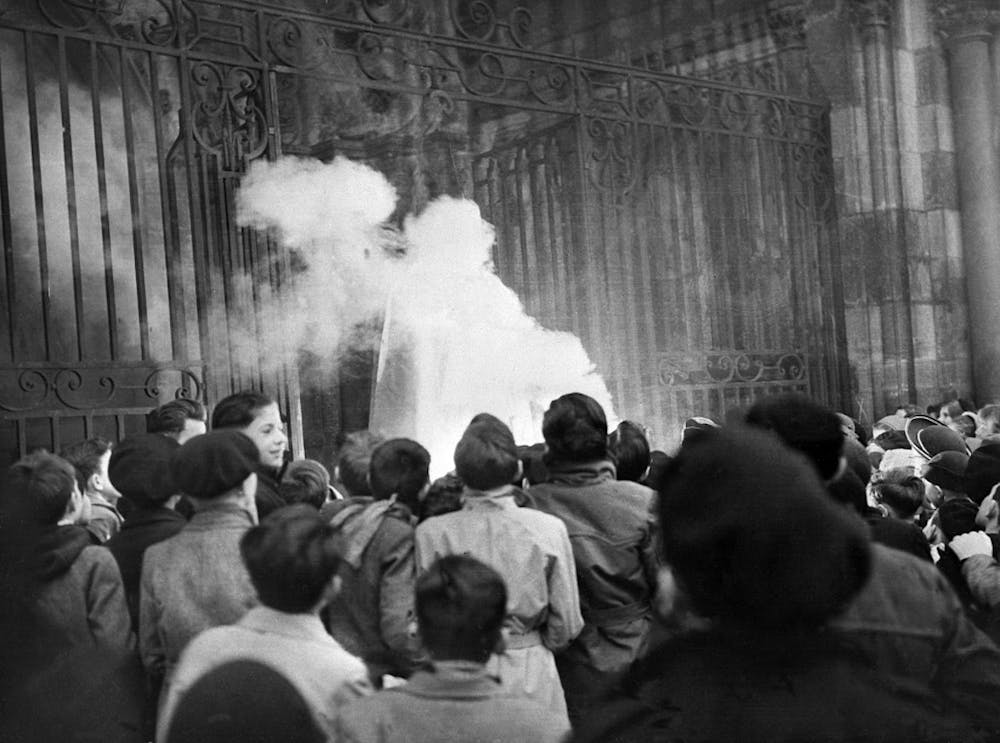
on December 23, 1951, in Dijon, France, a red-jacketed mannequin was burned
outside the city’s cathedral on the grounds that Saint Nick was a pagan
character that did not exist in real life. (This incendiary statement prompted
anthropologist Claude Lévi-Strauss to pen “The torture of Santa Claus”, a witty
and thoughtful essay.)
On December 24, 1951, an effigy of Santa Claus was burned at
Dijon’s cathedral on the grounds that it was a pagan character does not exist. Archives/AFP
Regardless of whether you see Christmas trees as a symbol of
the winter solstice or the Nativity, the odds are good that you’ll be
buying one this year. On Christmas night you will find them in 90% of UK
homes,77% of US households and nearly 25% in France – they even has a
measure of popularity in Australia, where Christmas occurs during the summer
vacation.
A Danish Nordmann for Sweden’s Ikea
Interestingly, most Christmas trees in Europe hail from the
realm of Denmark. Why? Because the country grows them on a massive scale,
making it the EU’s leading producer. But before going any further, we should
explain that these trees are no longer harvested in forests but farmed. So fear
not, you will do no damage to a real forest by purchasing a natural Christmas
tree.
Indeed, it is precisely because they no longer grow in
forests that Christmas trees come from neither Norway nor Sweden, despite these
countries’ abundant timber resources. Two figures may help clear things up: Denmark
produces about 10 million Christmas trees a year, with the domestic market
only absorbing 10%. The potential of farming firs appeared in the 1990s when
the country joined the European Union, with its system of farm subsidies.
Danish farmers were quick to adopt the Nordmann fir (Abies
nordmanniana). While it was more expensive than the spruce (Picea abies) and
doesn’t fill the room with a delicate smell of honey and resin, it sports
bluish cones and a long-lasting foliage with a silvery underside. Little seen
in modern homes in the 1960s, the Nordmann has gradually taken over.
If you’re European and buy your tree at the Swedish retailer
Ikea, the world’s biggest purchaser and seller of Christmas trees, it will
be Danish. The company goes so far as to make them a loss leader: You will pay
only 29 euros for the tree itself, along with baubles of various sizes and
prices that you had absolutely no intention of buying but which will somehow
land in your cart. You will receive a 20-euro voucher, to be spent on your next
visit (before the end of February), but that will almost certainly be spent on
another bunch of goodies of various sizes and prices…
Size and price
The advantage with Ikea, though, is that it only sells one
size of Christmas tree, 2 meters (roughly 6 feet) tall. So you don’t need
to dither about getting a smaller, cheaper one, or a bigger, more expensive
beast.
The theoretical relation between the size and price of a
Christmas tree involves extremely complex equations. Were I to say that you
should use a Hotelling-Faustmann type model you could be scarcely any the
wiser, so perhaps I should offer some explanation. Harold Hotelling was a
leading American economist and statistician, who established that the price of
a natural resource should increase at the same pace as interest rates. The
intuitive assumption is that the resource owner must choose between exploiting
it today or tomorrow. If tomorrow’s price is lower than the amount they would
earn from selling it today and putting the money in the bank, then they would
obviously opt to sell it straight away. So the difference in price between a
ten-year old Nordmann fir, that stands 0.6 feet taller, and a
nine-year-old tree depends on the rate of interest.
This is where Martin Faustmann, a German forester, comes in.
He pointed out that trees can be replanted once they have been cut down,
something that’s clearly not the case for coal or oil. If a farmer sells their
firs after ten years rather than nine, they lose one year’s growth on the
saplings they would have planted on the same plot of land. If this sparks your
curiosity and you like equations, take a look at the article in the American
Journal of Agricultural Economics, “A Hotelling-Faustmann Explanation of
the Structure of Christmas Tree Prices” (US economists are marvelous because
they publish papers on all sorts of subjects.)
Oregon, helicopters and Mexican trucks
It will come as no surprise that the United States both
produces and consumes the most Christmas trees. For instance, the Noble Mountain
Tree Farm grows the Noble fir (Abies procera), the Douglas fir (Pseudotsuga
menziesii) and the Scots pine (Pinus sylvestris) on almost 2,000 hectares. Once
felled, they are removed by helicopter, loaded onto trucks or refrigerated
containers, and shipped to the rest of the United States, to Central America
and even to places as far afield such as Doha, Singapore and Ho Chi Minh City.
Helicopter hoisting of firs in transport trucks in Oregon. Noble Mountain Tree Farm
On the other hand, you are less likely to know that
Oregon-grown Christmas trees have become entangled in a trade dispute between
the United States and Mexico. It started with a long argument about allowing Mexican
trucks onto US highways.. Under the North American Free Trade Association they
were set to gain access to the road network in 2000.
For reasons that are more or less convincing (safety issues
with vehicles, inexperienced truckers, trafficking of drugs and illegal
immigrants, among others), the federal authorities dragged their feet and its
trading partner finally lost patience. In 2009 the Mexican government imposed
several billion dollars’ worth of import surtaxes on about 100 categories of
goods, including Christmas trees. But why, you may wonder, did they bother with
the little firs? It was all the fault of two Congressmen from Oregon. So there
is a certain logic behind the targeting of retaliatory measures.
Chinese manufacturing
Christmas trees are also caught up in the trade war opposing
the United States and China. To be exact, it has more to do with fairy lights
and other seasonal decorations than it does with fir trees. The PRC does not
grow them, nor does it celebrate Christmas. What’s more, the Chinese New Year
is symbolized by an animal and the dominant colour is red, not green. (Next in
line is the year of the rat, which starts on February 5.) But China does
manufacture and export plastic Christmas trees and all the associated
trimmings. Indeed it by far the world’s largest producer.
As soon as the conflict erupted, Washington slapped 10%
extra duty on imports of Christmas decorations, but did not touch PVC or
polyurethane trees. Don’t ask me to explain this difference in treatment, as I
haven’t a clue. Nor could I say why the surcharge on trimmings was lifted last
summer. Perhaps Donald Trump was upset by the idea that kids at home would find
their trees a little bare…
Of course, there is only the faintest connection between
nursery tales and Chinese factories churning out Christmas decorations: no
elves with pointed ears nor mischievous imps assisting Santa Claus. Rather,
assembly-line workers and automated machines slicing PVC into countless
synthetic pine needles. Manufacturing is not located somewhere north of the
Polar Circle, but 300 kilometres southwest of Shanghai, in a city called Yiwu. Almost
1,000 firms making Christmas goods are based there. They account for 60% of
global output of plastic fir trees and Christmas lights, gilded stars and those
inevitable baubles. If you would like to
see the fan belts and choppers of this workshop of the Nativity world in
action, then watch the National Geographicvideo, “I Did Not Know That: How
Christmas Trees Are Made”. (It’s probably better to put the little ones to bed
first, though.)
The pros and cons of natural or artificial trees
In the United States, the volume of fake Christmas tree
sales is close to that of the real thing, and rising steadily. Its attractive
price – use it two years running and you start saving – is apparently not the
reason for this trend. Indeed a dip in demand only marginally
benefits their natural rival. Instead, their success in the United States
seems a matter of convenience: no early-December shopping run, no needles to
vacuum after the holidays.
In contrast, in France the market share of artificial trees
is pretty steady, stuck at about 20%. Which is just as well for local growers,
as Danish and other imports only account for a fifth of overall volume. The
French seem attached to their home-grown
Christmas trees.
Richelle/Shutterstock
But which tree is “greener”, natural or artificial? At first
glance a real tree seems a better bet: photosynthesis drives plant growth,
capturing carbon dioxide. The synthetic alternative causes emissions, through
oil extraction and PVC production, both of which consume large amounts of
energy. But two key parameters may wipe out this advantage: the years the
artificial tree is used and how far it is shipped (transportion also producing
emissions).
The longer you keep your plastic tree, the less it will
matter that it was made in China or that you bought it miles from your home. But
the further your natural Christmas tree travelled, the worse its carbon budget
will be. This ecological contest depends on other factors too, such as
end-of-life processing (landfill or recycling) and environmental damage other
than CO2 emissions (in particular, the impact of pesticides and
biodiversity). The results of the life-cycle analysis of the two commodities
vary depending on the relevant parameters and values. For instance, the tipping
point regarding re-use may be 5 years or 20 years, depending on the sources. In
short, it’s hard to tell.
For what it’s worth, I would advise you to opt for a natural
fir tree, on the condition that you don’t just trash it, but take it to the
nearest recycling centre. If in doubt, get a locally sourced tree or better
yet, an organic one.
Whatever happens, don’t make the same mistake as the envious
little tree in the Hand-Christian Andersen story, unable to appreciate
living in the present.
“Out in the woods stood a nice little Fir Tree. The place he
had was a very good one: the sun shone on him: as to fresh air, there was
enough of that, and round him grew many large-sized comrades, pines as well as
firs. But the little Fir wanted so very much to be a grown-up tree…”
And with this thought we wish you a very happy Christmas,
with or without a tree decked with Chinese-made decorations.
Author
François LévêqueReference:December 13, 2019
https://theconversation.com/the-amazing-growth-of-the-christmas-tree-128532


No comments:
Post a Comment