‘The world is going back to a GOLD STANDARD as the US dollar
is about to collapse’ –
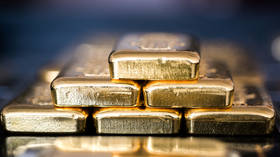
As the world grapples with Covid-19, precious metals’ prices
are pushing higher. Massive moves in gold and silver are coming, according to
veteran stockbroker Peter Schiff.
He says silver may hit $50 per ounce. The rally will be
short-lived, however, with Schiff describing the metal as “the new
bitcoin.”
The rise in gold and silver price is “about to explode” and
this is just the beginning of a much bigger move, according to Schiff.
“We’re barely getting started,” the CEO of Euro Pacific
said in his podcast. He
explained that is also coinciding with what’s happening to the US dollar,
because gold is the greenback’s “principle competitor” when it comes
to reserve assets.
Peter Schiff
What is the
gold standard?
How did it
come about? When and why was it abandoned? And why is there now in many
quarters a strong demand for its restoration?
We can best
understand the answers to these questions by a glance into history. In
primitive societies exchange was conducted by barter. But as labor and production
became more divided and specialized, a man found it hard to find someone who happened
to have just what he wanted and happened to want just what he had. So people
tried to exchange their goods first for some article that nearly everybody
wanted so that they could exchange this article in turn for the exact things
they happened to want.
This common
commodity became a medium of exchange—money.
All sorts
of things have been used in human history as such a common medium of
exchange—cattle, tobacco, precious stones, the precious metals, particularly
silver and gold. Finally gold became dominant, the "standard" money.
Gold had
tremendous advantages. It could be fashioned into beautiful ornaments and
jewelry. Because it was both beautiful and scarce, gold combined very high
value with comparatively little weight and bulk ; it could therefore be easily
held and stored. Gold "kept" indefinitely ; it did not spoil or rust;
it was not only durable but practically indestructible. Gold could be hammered
or stamped into almost any shape or precisely divided into any desired size or
unit of weight. There were chemical and other tests that could establish
whether it was genuine. And as it could be stamped into coins of a precise
weight, the values of all other goods could be exactly expressed in units of
gold. It therefore became not only the medium of exchange but the
"standard of value." Records show that gold was being used as a form
of money as long ago as 3,000 B.C. Gold coins were struck as early as 800 or
700 B.C.
One of
gold’s very advantages, however, also presented a problem. Its high value
compared with its weight and bulk increased the risks of its being stolen. In
the sixteenth and even into the nineteenth centuries (as one will find from
the plays of Ben Jonson and Moliere and the novels of George Eliot and Balzac)
some people kept almost their entire fortunes in gold in their own houses. But
most people came more and more into the habit of leaving their gold for
safekeeping in the vaults of goldsmiths. The goldsmiths gave them a receipt for
it.
The Origin
of Banks
Then came a
development that probably no one had originally foreseen. The people who had
left their gold in a goldsmith’s vault found, when they wanted to make a
purchase or pay a debt, that they did not have to go to the vaults themselves
for their gold. They could simply issue an order to the goldsmith to pay over
the gold to the person from whom they had purchased something. This second man
might find in turn that he did not want the actual gold; he was content to
leave it for safekeeping at the goldsmith’s, and in turn issue orders to the
goldsmith to pay specified amounts of gold to still a third person. And so on.
This was
the origin of banks, and of both bank notes and checks.
If the
receipts were made out by the goldsmith or banker himself, for round sums
payable to bearer, they were bank notes. If they were orders to pay made out by
the legal owners of the gold themselves, for varying specified amounts to be
paid to particular persons, they were checks. In either case, though the
ownership of the gold constantly changed and the bank notes circulated, the
gold itself almost never left the vault !
When the
goldsmiths and banks made the discovery that their customers rarely demanded
the actual gold, they came to feel that it was safe to issue more notes
promising to pay gold than the actual amount of gold they had on hand. They
counted on the high unlikelihood that everybody would demand his gold at once.
This
practice seemed safe and even prudent for another reason. An honest bank did
not simply issue more notes, more IOU’s, than the amount of actual gold it had
in its vaults. It would make loans to borrowers secured by salable assets of
the borrowers. The bank notes issued in excess of the gold held by the bank
were also secured by these assets. An honest bank’s assets therefore continued
to remain at least equal to its liabilities.
There was
one catch. The bank’s liabilities, which were in gold, were all payable on demand, without
prior notice. But its assets, consisting mainly of its loans to customers, were
most of them payable only on some date in the future. The bank might be
"solvent" (in the sense that the value of its assets equaled the
value of its liabilities) but it would be at least partly "illiquid."
If all its depositors demanded their gold at once, it could not possibly pay
them all.
Yet such a
situation might not develop in a lifetime. So in nearly every country the banks
went on expanding their credit until the amount of bank-note and demand-deposit
liabilities (that is, the amount of "money") was several times the
amount of gold held in the banks’ vaults.
The
Fractional Reserve
In the United
States today there are $11 of Federal Reserve notes and demand-deposit
liabilities—i.e., $11 of money—for every $1 of gold.
Up until
1929, this situation—a gold standard with only a "fractional" gold
reserve—was accepted as sound by the great body of monetary economists, and
even as the best system attainable. There were two things about it, however,
that were commonly overlooked. First, if there was, say, four, five, or ten
times as much note and deposit "money" in circulation as the amount
of gold against which this money had been issued, it meant that prices were far
higher as a result of this more abundant money, perhaps four, five, or ten
times higher, than if there had been no more money than the amount of gold. And
business was built upon, and had become dependent upon, this amount of money
and this level of wages and prices.
Now if, in
this situation, some big bank or company failed, or the prices of stocks
tumbled, or some other event precipitated a collapse of confidence, prices of
commodities might begin to fall ; more failures would be touched off ; banks
would refuse to renew loans ; they would start calling old loans ; goods would
be dumped on the market. As the amount of loans was contracted, the amount of
bank notes and deposits against them would also shrink. In short, the supply of
money itself would begin to fall. This would touch off a still further decline
of prices and buying and a further decline of confidence.
That is the
story of every major depression. It is the story of the Great Depression from
1929 to 1933.
From Boom
to Slump
What
happened in 1929 and after, some economists argue, is that the gold standard
"collapsed." They say we should never go back to it or depend upon it
again. But other economists argue that it was not the gold standard that
"collapsed" but unsound political and economic policies that
destroyed it. Excessive expansion of credit, they say, is bound to lead in the
end to a violent contraction of credit. A boom stimulated by easy credit and
cheap money must be followed by a crisis and a slump.
In 1944,
however, at a conference in Bretton Woods, New Ham-shire, the official
representatives of 44 nations decided—mainly under the influence of John
Maynard Keynes of Great Britain and Harry Dexter White of the United States—to
set up a new international currency system in which the central banks of the
leading countries would cooperate with each other and coordinate their currency
systems through an International Monetary Fund. They would all deposit
"quotas" in the Fund, only one-quarter of which need be in gold, and
the rest in their own currencies. They would all be entitled to draw on this
Fund quickly for credits and other currencies.
The United
States alone explicitly undertook to keep its currency convertible at
all times into gold. This privilege of converting their dollars was not given
to its own citizens, who were forbidden to hold gold (except in the form
of jewelry or teeth fillings) ; the privilege was given only to foreign
central banks and official international institutions. Our government pledged
itself to convert these foreign holdings of dollars into gold on demand at the
fixed rate of $35 an ounce. Two-way convertibility at this rate meant that a
dollar was the equivalent of one-thirty-fifth of an ounce of gold.
The other
currencies were not tied to gold in this direct way. They were simply tied to
the dollar by the commitment of the various countries not to let their currencies
fluctuate (in terms of the dollar) by more than 1 per cent either way from
their adopted par values. The other countries could hold and count dollars as
part of their reserves on the same basis as if dollars were gold.
International
Monetary Fund Promotes Inflation
The system
has not worked well. There is no evidence that it has "shortened the
duration and lessened the degree of disequilibrium in the international
balances of payments of members," which was one of its six principal
declared purposes. It has not maintained a stable value and purchasing power of
the currencies of individual members. This vital need was not even a declared
purpose.
In fact,
under it inflation and depreciation of currencies have been rampant. Of the 48
or so national members of the Fund in 1949, practically all except the United
States devalued their currencies (i.e., reduced their value) that year
following devaluation of the British pound from $4.03 to $2.80. Of the 102
present members of the Fund, the great majority have either formally devalued
since they joined, or allowed their currencies to fall in value since then as
compared with the dollar.
The dollar
itself, since 1945, has lost 43 per cent of its purchasing power. In the last
ten years alone the German mark has lost 19 per cent of its purchasing power,
the British pound 26 per cent, the Italian lira 27 per cent, the French franc
36 per cent, and leading South American currencies from 92 to 95 per cent.
In
addition, the two "key" currencies, the currencies that can be used
as reserves by other countries—the British pound sterling and the U. S.
dollar—have been plagued by special problems. In the last twelve months the
pound has had to be repeatedly rescued by huge loans, totaling more than $4
billion, from the Fund and from a group of other countries.
Balance of
Payments
The United
States has been harassed since the end of 1957 by a serious and apparently
chronic "deficit in the balance of payments." This is the name given
to the excess in the amount of dollars going abroad (for foreign aid, for
investments, for tourist expenditures, for imports, and for other payments)
over the amount of dollars coming in (in payment for our exports to foreign
countries, etc.). This deficit in the balance of payments has been running
since the end of 1957 at a rate of more than $3 billion a year. In the
seven-year period to the end of 1964, the total deficit in our balance of
payments came to $24.6 billion.
This had
led, among other things, to a fall in the amount of gold holdings of the United
States from $22.9 billion at the end of 1957 to $13.9 billion now—a loss
of $9 billion gold to foreign countries.
Other
changes have taken place. As a result of the chronic deficit in the balance of
payments, foreigners have short-term claims on the United States of
$27.8 billion. And $19 billion of these are held by foreign central banks and
international organizations that have a legal right to demand gold for them. This
is $5 billion more gold than we hold altogether. Evenof the $13.9 billion gold
that we do hold, the Treasury is still legally obliged to keep some $8.8
billion against outstanding Federal Reserve notes.
This is why
officials and economists not only in the United States but all over
the Western world are now discussing a world monetary reform. Most of them are
putting forward proposals to increase "reserves" and to increase
"liquidity." They argue that there isn’t enough
"liquidity"—that is, that there isn’t enough money and credit, or
soon won’t be—to conduct the constantly growing volume of world trade. Most
of them tell us that the gold standard is outmoded. In any case, they say,
there isn’t enough gold in the world to serve as the basis for national
currencies and international settlements.
The
Minority View
But the
advocates of a return to a full gold standard, who though now in a minority
include some of the world’s most distinguished economists, are not impressed
by these arguments for still further monetary expansion. They say these are
merely arguments for still further inflation. And they contend that this
further monetary expansion or inflation, apart from its positive dangers, would
be a futile means even of achieving the ends that the expansionists
themselves have in mind.
Suppose,
say the gold-standard advocates, we were to double the amount of money now in
the world. We could not, in the long run, conduct any greater volume of
business and trade than we could before. For the result of increasing the
amount of money would be merely to increase correspondingly the wages and
prices at which business and trade were conducted. In other words, the result
of doubling the supply of money, other things remaining unchanged, would be
roughly to cut in half the purchasing power of the currency unit. The process
would be as ridiculous as it would be futile. This is the sad lesson that
inflating countries soon or late learn to their sorrow.
The Great
Merit of Gold
The
detractors of gold complain that it is difficult and costly to increase the
supply of the metal, and that this depends upon the "accidents" of
discovery of new mines or the invention of better processes of extraction. But
the advocates of a gold standard argue that this is precisely gold’s great
merit. The supply of gold is governed by nature; it is not, like the supply of
paper money, subject merely to the schemes of demagogues or the whims of politicians.
Nobody ever thinks he has quite enough money. Once the idea is accepted that
money is something whose supply is determined simply by the printing press, it
becomes impossible for the politicians in power to resist the constant
demands for further inflation. Gold may not be a theoretically perfect basis
for money ; but it has the merit of making the money supply, and therefore the
value of the monetary unit, independent of governmental manipulation and
political pressure.
And this is
a tremendous merit. When a country is not on a gold standard, when its citizens
are not even permitted to own gold, when they are told that irredeemable paper
money is just as good, when they are compelled to accept payment in such paper
of debts or pensions that are owed to them, when what they have put aside, for
retirement or old-age, in savings banks or insurance policies, consists of
this irredeemable paper money, then they are left without protection as the
issue of this paper money is increased and the purchasing power of each unit
falls ; then they can be completely impoverished by the political decisions of
the "monetary managers."
I have just
said that the dollar itself, "the best currency in the world," has
lost 43 per cent of its purchasing power of twenty years ago. This means
that a man who retired with $10,000 of savings in 1945 now finds that that
capital will buy less than three-fifths as much as it did then.
But
Americans, so far, have been the very lucky ones. The situation is much worse
in England, and still worse in France. In some South American
countries practically the whole value of people’s savings—92 to 95 cents in
every dollar—has been wiped out in the last ten years.
Not a
Managed Money
The
tremendous merit of gold is, if we want to put it that way, a negative one : It
is not a managed paper money that can ruin everyone who is legally
forced to accept it or who puts his confidence in it. The technical criticisms
of the gold standard become utterly trivial when compared with this single
merit. The experience of the last twenty years in practically every country
proves that the monetary managers are the pawns of the politicians, and cannot
be trusted.
Many
people, including economists who ought to know better, talk as if the world
had already abandoned the gold standard. They are mistaken. The world’s
currencies are still tied to gold, though in a loose, indirect, and precarious
way. Other currencies are tied to the American dollar, and convertible into it,
at definite "official" rates (unfortunately subject to sudden change)
through the International Monetary Fund. And the dollar is still, though in an
increasingly restricted way, convertible into gold at $35 an ounce.
Indeed, the
American problem today, and the world problem today, is precisely how to
maintain this limited convertibility of the dollar (and hence indirectly of
other currencies) into a fixed quantity of gold. This is why the American loss
of gold, and the growing claims against our gold supply, are being viewed with
such concern.
The $35 Question
The crucial question that the world has now to answer is
this: As the present system and present policies are rapidly becoming untenable,
shall the world’s currencies abandon all links to gold, and leave the supply
of each nation’s money to be determined by political management, or shall the
world’s leading currencies return to a gold standard—that is, shall each leading
currency be made once again fully convertible into gold on demand at a fixed
rate?
Whatever may have been the shortcomings of the old gold standard,
as it operated in the nineteenth and the early twentieth century, it gave the
world, in fact, an international money. When all leading currencies were
directly convertible into a fixed amount of gold on demand, they were of
course at all times convertible into each other at the equivalent fixed cross
rates. Businessmen in every
country could have confidence in
the
currencies of other countries. In final settlement, gold was the one
universally acceptable currency everywhere. It is still the one universally
acceptable commodity to those who are still legally allowed to get it.
Instead of
ignoring or deploring or combating this fact, the world’s governments might
start building on it once more.

No comments:
Post a Comment